The effect of Zhang v R on meth sentencings, or, very bad statistics

EDIT (17 May 2020): Of course as soon as I published this three more cases that were not on the databases were published in LawPoints.  The tables and figures have been updated.


We are in lockdown and the moon of public law is ominously full.  The nights draw in and we must now all suffer through a judicial review to find out whether it’s Dr Ashley Bloomfield or Dr Rashly Bloomfield.  Vic academics stalk the airwaves.  To go out after dark is to risk encountering the fearsome Geddis, whose footfalls on the cobbles cause lanterns to flicker.  Rumours swirl that Walker J has been feeding mandatory interim relief steroids in her basement.

We need distraction, and what better distraction than methamphetamine?

Zhang v R [2019] NZCA 507, [2019] 3 NZLR 648 set a new guideline judgment for methamphetamine sentencing.  I wrote about it here, pretended to write about it here, and tweeted about it here.

Anyway, like me, I am sure you have noticed that this week a bunch of new Court of Appeal cases went up on NZLII all applying Zhang to old meth sentences.  It seems Miller, Dobson and Moore JJ drew the short straw and had to deal with them all in a week of Crim Div sittings.

That got me thinking about whether it was possible to figure out the effect of Zhang on meth sentences.  I think it’s fair to say that the vibe is that Zhang represents a more generous approach.  More concretely, Zhang permits discounts for personal factors in drug cases.  So it’s “generous” in the sense that it treats drug sentencing like other sentencing.  It also fiddled with bands for starting point, that hints at  lower starting points.

Are there numbers to back any of that up?

The short answer is yes.  The long answer is yes, but they’re bad numbers.  So, purely for entertainment purposes and making no claim to serious academicianship (a disclaimer which probably needs to go in a banner at the top of this site), let’s look at the numbers.


Methodology

Those recent Court of Appeal cases I mentioned are part of a small crop of sentencing appeals in which an appellate court (either the High Court or Court of Appeal) has applied Zhang to a sentence imposed according to the Fatu approach.  These cases allow direct comparison of the two cases.  Actual judges have applied both sentencing approaches to the same facts.  They’re a rare species though.  As Zhang itself points out, Zhang only applies to appeals filed before the judgment in Zhang was issued (and where the application of Zhang will result in a lower sentence).  My search of the database revealed 15 decisions that featured this comparison.  Of that figure of 15, six of the cases were the individual cases discussed in the Zhang combined appeal.

Methodology is difficult for any number of reasons, and the combined problems bork the numbers something terrible.  For example, what starting point do you compare?  Overall starting point is not necessarily just methamphetamine.  It might be set higher to account for other offences committed at the same time.  Comparison with the new starting point figure might show a reduction, but the percentage figure will be affected by the uplift for non-meth offences which Zhang won’t (necessarily) have affected.

You can solve that by comparing just the components of the starting points that relate to meth offending.  But that information is not available in every case because the appellate judgments sometimes don’t record that information clearly.  That reduces the number of cases in the sample from an already dangerously slim 15.

You need to compare end points too, since Zhang does work at reducing end points by conferring the possibility of further discounts for personal factors.

But in all of this, the thing you can’t account for easily is simple error correction.  The appellate court is not necessarily just waving Zhang over an old Fatu sentence.  It is also – potentially – disagreeing with a sentencing judge’s assessment of facts or levels of discount.  If the Court of Appeal increased the discount for a guilty plea on ordinary appellate principles rather than the application of Zhang, then a simple comparison of end point risks wrongly attributing that reduction of sentence to Zhang.

Lastly, I was concerned that these cases might be self-selecting in a way.  Ignoring the real world for a second, you should bring an appeal if you think you stand a chance of getting a lower sentence.  So by only looking at cases where appeals have been brought, you risk limiting your sample to cases where an appellant has already identified they have a chance of lowering their sentence.  In other words, it isn’t a random sample.  I think this is of slightly lesser concern that it might be otherwise because all these appellants had to file their appeal without knowing what Zhang would say.  And while everyone sort of assumed Zhang would help, no one could guarantee that.  In the event, in several of these cases the appellate court has not altered the starting point or the end sentence or both.

Taking all of these caveats together means I don’t think that the numbers can really tell us anything at all.  So let’s see what they don’t tell us.


Results

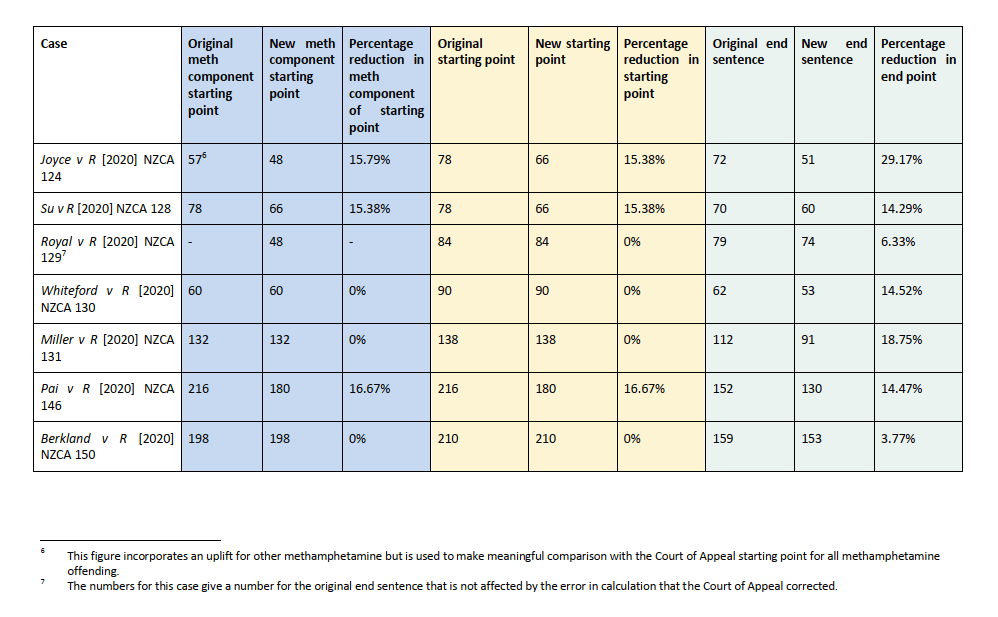
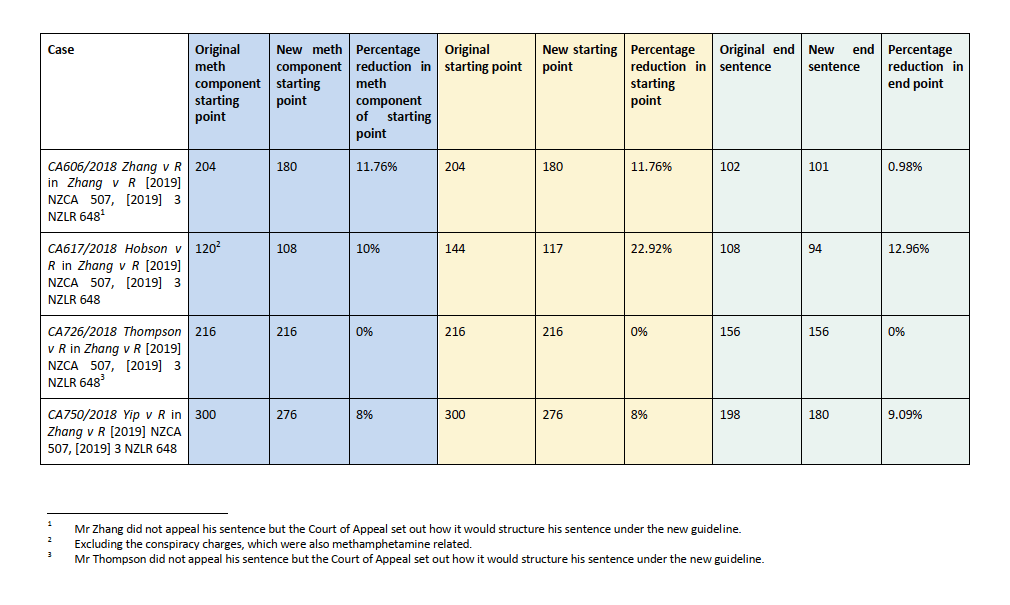
Part of being Bad At Numbers is that I don’t know how to use Excel.  I am also Bad At WordPress so I don’t know how to insert tables in a blog post.  But below are screenshots of a table I made in Word and manually calculated.  Hopefully you can make these big enough to read.

TableATableBTableCTableD


The average reduction in the meth component of the starting point: 8.5%

The average reduction in the overall starting point: 11.76%

The average reduction in end sentence: 19.56%


What does this mean?

I’m not convinced it means anything really.  The sample size is small.  It doesn’t indicate the Court of Appeal is soft on methamphetamine sentencing since the reduction in sentence is not really from the lowering of starting points.  Instead, the reduction is from the application of personal mitigating factors that Zhang.  And that’s assuming you can attribute the discount to a change brought about by Zhang and not correction of another non-Zhang error by the Court of Appeal.  Or, to quote Tom Lehrer, it’s “full of words and music and signifying nothing”.

And if it’s a proper numerical analysis of law that you really want, well I’ve got you covered.


Supplementary Remote Hearing Protocol for Courts of New Zealand

This supplementary remote hearing protocol is to be read in conjunction with whatever iteration of new guidance one of the courts put out today.  It applies to all remote hearings conducted at levels one, two, three, four, and the hidden level five that you can only unlock by completing all the other levels first.


Business of the courts

All courts will continue to hear priority proceedings, these include bail applications and appeals, applications for freezing orders, and all spurious and non-spurious applications for habeas corpus.

Owing to the spirit of the times the Courts will not hear arguments relating to duties of care in negligence that turn on proximity, or contractual interpretation claims that turn on the doctrine of infection.


Hearings by AVL

Most hearings are now by AVL.  All courts use the same VMR technology.  The High Court and District Court permit the use of Zoom but for some reason the Court of Appeal forbids it.  It is not intended that any explanation will be given about that.

While not accepting Zoom, the Court of Appeal will permit you to appear remotely by Snapchat, recording your submissions in a series of Snapchat videos, to be sent to the registry.  Questions from the bench will be sent to you by return Snapchat video and, if the judge thinks the question is a really zingy one, posted to the Court of Appeal’s Snap story.

Supreme Court hearings will be facilitated exclusively through Houseparty.

If Houseparty is unavailable, then counsel are permitted to travel to the nearest Supreme Court Justice’s bubble and shout their submissions from the footpath.

At the end of a hearing, the matter will be adjourned apart heard.


AVL hearing etiquette

Counsel will be muted when not making submissions and, at the discretion of the Court, muted when making them too.

Counsel are not required to be gowned except when it comes to dressing gowns in which case counsel are required not to be gowned.

A formal standard of attire is required – after all, you’re not in the District Court any more.

You are not required to stand when the judges enter, unless you think giving the bench a close up of your crotch will help your case in which case go for it.


Hearings in person

Hearings in person will continue to be conducted (either in person in their entirety or partially through AVL to facilitate the attendance of one or more participants).  The following modifications will apply:

  • Queen’s Counsel seating priority now means they will sit furthest from the bench.
  • Witnesses being sworn-in will be asked to place their hand two metres from a Bible.
  • The Court will not accept any documents to be handed up.  Instead, any documents should be printed on size A1 paper in at least size 72 font, so that they can be read from a safe distance.
  • Should any physical exhibit need to be inspected, it should not be handed up.  Instead, it should be left outside the courtroom in a sufficiently open and ventilated space.  The Court will then use its powers to undertake a view pursuant to s 82 of the Evidence Act 2006.


Other matters

Please avoid the following phrases in written and oral submissions:

  • Just to touch on this next point.
  • Hand in glove.
  • A close reading of the statutory text.
  • Noscitur a sociis.


Members of Supreme Court regretting choosing to bubble together

Empty halls
The halls of the Supreme Court are empty as the Justices give each other the silent treatment.


Eight days in to the nationwide category 4 lockdown, tensions are running high within the Supreme Court “bubble”.  Having opted to isolate together within the Supreme Court building in Wellington, the six members of the Court now face at least three more increasingly fractious weeks together.

The initial decision to spend the four weeks together was driven by the Chief Justice’s determination that, as an essential service, the Supreme Court would continue to operate.  At the time the lockdown was initiated the Supreme Court lacked remote working capability as Glazebrook J had lost the charger for the Court’s shared, Ministry-provided Nokia 2280.  That prompted a decision that the members of the Court would form a bubble together that would be based in their chambers in the Supreme Court.

To outward appearances that decision has seemed to work well, with the Supreme Court continuing to issue leave decisions and a substantive decision in Lodge Real Estate Ltd v Commerce Commission [2020] NZSC 25.  However, individual members of the Court, contacting this blog under conditions of anonymity, have indicated that close confinement with their judicial colleagues is proving difficult for members of the Court.

“I’ll tell you what’s not an essential service,” said one member of the Court, “and that’s William Young J playing Kenny Rogers songs on full blast in his chambers.  Or the time when Ellen France J did the shopping and bought blue top milk.”

“I could be at home with my family during all of this,” said another.  “Instead, the Chief Justice is making us all bed down every night in sleeping bags spread out around the seats in the courtroom.”

“The only reason that there weren’t five separate judgments in Lodge Real Estate was because we had written most of it before the lockdown.  It’s like the old saying about joining an appellate court: at the start of your time you figure you must be wrong, but the longer you spend the more you realise that no it’s actually your colleagues.”

The Ministry of Justice is currently exploring upgrading the Court’s Netflix subscription so that it can be played on more than two devices at the same time.  This is said to be essential as “everyone but Helen has seen season three of The Crown and no one wants to watch it again”.

In a further letter to the profession expected to be issued on Monday, Chief Justice Winkelmann will write that “New Zealand courts must continue to uphold the
rule of law and to ensure that fair trial rights, the right to natural justice and rights under the New Zealand Bill of Rights Act are upheld, as well as ensuring that no dirty dishes are left in the common room sink, Ellen.”


On sparrows

My workplace was already dealing with a public health crisis when Covid-19 began its acceleration here.  A sparrow had made its way into our fancy glass atrium and had taken up residence.  It’s been there four weeks now, living off crumbs of Huntley and Palmers set out as bait to lure it towards a cage it otherwise ignores.  Its leisure activities mainly seem to involve shitting over our furniture.  Most recently, some enterprising solicitor propped up an upside down cardboard file box on a binding comb.  String tied to the binding comb could be yanked to make the box pounce.  A sort of Wile E Coyote solution designed by desperate lawyers.

Now, almost all of us have been sent to work from home.  I assume the sparrow is still there.  Defiant.

Me, I’m following orders.  It seems the only responsible thing to do.  Obtaining permission to return to the office for a day now requires an originating application and supporting affidavit.  Presumably when we reach category 4 shortly it will be all but impossible.

In a time of a large scale public health crisis, the market for nonsense should be small.  I am loathe to contribute to the supply.  Somehow, tweeting that barristers wigs are to be lengthened to mid-arm (coiffing to your elbow) doesn’t seem like the order of the day.  (Besides, all the easy jokes have been taken.  Clean hands; we get it.  Call me when there is something original like the QC seating priority being reversed so that QCs are entitled to sit on the seat *furthest* from the bench, or all opt-out representative actions are changed back to opt-in.)

I was this close – *this* *close* – to writing a whole thing about the Chief Justice calling on all practitioners to stop citing cases that are over 70 years old.  But with the announcements today it all seems pretty naive.

It would be nice if we could carry on as normal.  I would like it even more if we could  romanticise the practise of law to a level on par with nursing or supermarket shelf stacking.  (Alas, I gave up my early career as checkout chap at Mosgiel New World to practice law; a choice which I’ve long suspected and now confirmed to be a backwards step.)  Law will be essential to achieve a lot of good in a difficult time.  The Chief Justice is right that the courts must remain open even at category 4.  But for each of us, the ability to do some good, even a lot of good, can’t be mistaken for the idea that everything we do is good.  The situation calls for an acceptance of limits and to follow public health advice, which for now is to limit social contact as much as possible.

Getting admitted as a barrister and solicitor of the High Court of New Zealand means that, when faced with crisis, we all have to leap to our feet valiantly and proclaim things like “Even in times of war, the laws do not fall silent”.  Well, it turns out that in a pandemic, the laws do not fall silent but they do have a scratchy throat.  We can all do our jobs while taking sensible precautions.

That will be tough on all the egotists among us, me included.  It will be tough on counsel having to appear by telephone, who lose the ability to share that very special locked-eyes “I’ve no fucking idea what he’s on about either” look with the judge while opposing counsel is speaking.  It will be tough on judges who have to listen to my oral submissions delivered entirely in “telephone voice”.  It will be tough on all of us forced to confront the idea that the judgment we’re reading may have been written by a judge at home and not wearing pants.

It’s not my place to say anything profound.  And I don’t think anyone should necessarily have a sense of humour about something that is all but certain to lead to deaths.  It’s also not my place to deliver public health advice.  But it occurs to me we have two options.  We can be sensible lawyers who follow official advice while upholding our oaths, or we can be sparrows shitting over everything.

See you all when this is over.

Latest Supreme Court decision bad news for Chief Justice

The Chief Justice’s last, best hope to avoid having to host a dinner with the profession has been dashed.  Options to get out of hosting an ADLS dinner at the Northern Club on 13 March 2020 are now severely limited following the Supreme Court’s reasons in Minister of Justice v Kim [2020] NZSC 18.

Today’s decision (from a panel that did not include the Chief Justice) held that extrajudicial engagements do not, in and of themselves, affect a judge’s ability to sit.  That had the effect of confirming that there is no legal reason that would prevent the Chief Justice having to pretend to enjoy socialising with 200 people whose idea of a good time is dinner at the Northern Club.

The Supreme Court’s decision was limited to whether appointment under the Inquiries Act 2013 affects judicial independence in the context of William Young J’s appointment to the Royal Commission of Inquiry into the Attack on the Christchurch Mosques on 15 March 2019 and Arnold J’s appointment to the Government Inquiry into Operation Burnham and Related Matters.  The decision contained no helpful obiter observations about whether punishing public dinners on a Friday night might also affect judicial independence, despite “[b]oth the Senior Courts Act and the Inquiries Act [being] silent on the point” as well (Kim at [30]).   Nor did it make any comment on the latent injustice of having to suffer through these sorts of dinners in arm’s reach of sobriety for the sake of public perception.

The Supreme Court confirmed the Saxmere test for apparent bias continues to apply, however bloodstock agents confirmed that, due to new AML regulations, a purchase of a share in a racehorse was unlikely to be able to be effected before 6.30pm on Friday 13 March 2020.  Efforts by clerks late Thursday to locate an extant application for leave to appeal to the Supreme Court that somehow involved either the Northern Club or ADLS proved unsuccessful also.

The Chief Justice’s speech for the dinner currently consists of an entry in her phone’s Notes app that records it wasn’t until her fourth year of being a partner in a law firm that the Northern Club started admitting women as members.

Akuhata v R [2020] NZCA 19 – appellate consequences of a failure to engage s 27 of the Sentencing Act 2002 at first instance

Akuhata v R [2020] NZCA 19 contains a reasonably rare dissent in the Court of Appeal.  What is an appellate court to do if there has been no resort to s 27 of the Sentencing Act 2002 in a sentencing decision?

The particular facts of Akuhata mean both the majority and minority can suggest only partial answers.  That means the issue will need to be confronted again, later.  But, for now, different judges point in different directions and speak to a wider debate about the significance of s 27.

Mr Akuhata pleaded guilty to murder.  He was sentenced to life imprisonment with a minimum non-parole period of 15 years. At his sentencing his counsel did not seek to use s 27(1) of the Sentencing Act 2002.  Section 27(1) provides:

(1) If an offender appears before a court for sentencing, the offender may request the court to hear any person or persons called by the offender to speak on—

(a) the personal, family, whanau, community, and cultural background of the offender:

(b) the way in which that background may have related to the commission of the offence:

(c) any processes that have been tried to resolve, or that are available to resolve, issues relating to the offence, involving the offender and his or her family, whanau, or community and the victim or victims of the offence:

(d) how support from the family, whanau, or community may be available to help prevent further offending by the offender:

(e) how the offender’s background, or family, whanau, or community support may be relevant in respect of possible sentences.

To save scrolling back to look at this section later, note that the section is permissive.  An offender “may” request the Court.

A Court “must” give effect to any request made, unless the Court is satisfied of “special reasons” not to (Sentencing Act 2002, s 27(2)).

But s 27(1) doesn’t have to be triggered only by an offender.  The Court has the ability to be proactive.  Section 27(5) provides:

(5) If an offender does not make a request under this section, the court may suggest to the offender that it may be of assistance to the court to hear a person or persons called by the offender on any of the matters specified in subsection (1).

Again, the Court “may” do this.  So s 27 has two ways to be engaged.  Both of them permissive.

At his sentencing, the judge did not make a suggestion under s 27(5).

So Mr Akuhata was sentenced without recourse to s 27.  No one spoke to the matters listed in s 27(1) (nor, as is more common, was there any s 27 “report”).

Two years later, Mr Akuhata applied for leave to appeal his sentence out of time. One of his appeal grounds was the fact that he was sentenced without recourse to s 27.  The majority recorded the appeal ground as being aimed at the fact the sentencing judge had not made a suggestion under s 27(5), rather than a failure of counsel to advance a request under s 27(1) (at [147]-[149]).

In his application for leave to appeal out of time, Mr Akuhata did not provide a s 27 report or other information that he said should have (but was not) taken into account.  The Court of Appeal knew Mr Akuhata was a Māori man of Ngā Puhi descent who lived in Northland.  And it had psychiatric and psychological reports before it as a result of a conviction appeal that Mr Akuhata also advanced.  But beyond that it had no further information supporting the application for leave to appeal the sentence out of time.

Mr Akuhata could establish clearly that an avenue which *might* have provided a discount had not been pursued.  But he could only speculate whether it could have or would have provided a discount.

How to treat such a situation?  The judges split.  The majority (Wild and Katz JJ) declined the application for leave to appeal out of time.  The minority (Whata J) would have permitted Mr Akuhata to obtain and file material he wanted considered under s 27, before the Court determined the application for leave to appeal out of time.


The majority view

Writing for the majority, Wild J began by stating that “a failure to engage s 27 could provide a proper basis to reconsider sentence, in an appropriate case” (at [151]).  That has to be right.  It is the same with any sentencing factor that is overlooked at first instance, regardless of whether it is overlooked unknowingly or even negligently.  The whole point of appeals is to fix error.

Sentence appeals require an appellant to satisfy an appellate court that an error exists, of a type that meant the end sentence was manifestly excessive.  To do that, an appellant generally needs to be able to point to evidence (excluding things purely internal to the decision under appeal like arithmetical error).

A failure to engage s 27 leaves the Court of Appeal with a known unknown.  But establishing a known unknown isn’t enough on a sentence appeal: “the appellant must provide enough information to satisfy the Court that the failure to engage the s 27 process has resulted in the overlooking of matters that may have impacted on sentence” (at [151]).

The majority then pivoted to the facts of the case.  In the majority’s view “[n]one of the many medical reports to the High Court, nor the pre-sentence report, contains any suggestion that Mr Akuhata’s criminal offending had its genesis in social deprivation or in any other matter that might have come to the fore in material adduced under s 27” (at [153]).  The majority was careful to state that it did not suggest the reports could take the place of a s 27 report, but rather that their extensive canvassing of Mr Akuhata’s history may have explained why neither trial counsel nor the sentencing judge turned their minds to s 27 (at [156]).

Finally, the majority noted the overarching question was whether the life sentence with a 15 year minimum non-parole period could be said to be manifestly excessive.  It held that it could not be said to be manifestly excessive.  Life imprisonment was mandatory,  The only discount was to the minimum non-parole period of 17 years.  A fifteen year MPI “appropriately reflected the discount that was properly available to Mr Akuhata for his guilty plea” (at [157]).

This last point seems to beg the question, though.  Almost everyone would agree that the sentence actually imposed was correct on the information known to the sentencing judge (including the guilty plea discount).  Mr Akuhata’s argument was that there was information (or might be information) not known to the sentencing judge.  The majority’s reliance on simply the guilty plea discount doesn’t grapple with that at all.


The minority view

Writing in dissent, Whata J explained his reasons for why he would have permitted Mr Akuhata to obtain and file the information he said should have been considered under s 27.  The minority view was informed by the importance of s 27 as set out in Zhang v R [2019] NZCA 507 at [159]-[162].  Whata J humbly didn’t cite Solicitor-General v Heta [2018] NZHC 2453, [2019] 2 NZLR 241 but the majority pointed out that he very well could have.

Whata J placed emphasis on the Court of Appeal’s reference to a “right” to address the Court under s 27.  His Honour’s reasoning was that:

[160] The full Court’s reference to an offender’s “right” to address the court emphasises the importance of the s 27 process to the sentencing. For my part then, the failure to engage s 27 may provide a proper basis for reconsideration of sentence by this Court on appeal. It also evident that [trial counsel for Mr Akuhata] did not request [the sentencing judge] pursuant to s 27(1), to hear from any person or persons and [the sentencing judge] did not suggest that it would assist her to hear from such persons. It seems to me then that there is a real issue to be considered on appeal, namely whether the sentencing process was procedurally and substantively unfair to Mr Akuhata because of the apparent omission to engage s 27.

[161] I acknowledge that, unhelpfully, we do not know what material the exercise of power might have produced. I also acknowledge that the information available to the Court suggests that the omission may not be material to the result for the reasons expressed by Wild and Katz JJ at [157]. And it counts strongly against Mr Akuhata that he has not already identified the s 27 information he says was and is relevant to his sentence. But given the procedural as well as substantive significance of the s 27 process to sentencing, as affirmed by the full Court in Zhang, the added burden to the Crown and to the Court of affording Mr Akuhata the opportunity to identify the relevant s 27 matters is in my view justified.

In other words, you haven’t done this properly.  You should have done it better and been more organised.  But s 27 has such “procedural as well as substantive significance” that you may have a further chance to obtain the information.  If something as vital as the s 27 process has gone wrong (in this case, that it has not been engaged at all), then that creates a risk of unfairness that an appellate court cannot treat as probably not leading to error.


Thoughts

First, it’s important to recognise that the members of the Court are not that far apart at all.  The majority would grant (at least some) sentence appeals based on a failure to have recourse to s 27.  You just need to show them that the failure had a significance.  And the minority is not saying it would grant appeals on a speculative basis.  All it would do is give greater freedom to try to obtain the necessary information.  If those efforts do not result in persuasive evidence then your appeal may well be dismissed.

Second, the split arose on unusual facts but perhaps not practically rare facts.  Best practice if you are arguing a sentence appeal on the grounds that factor X warranted a discount will be to marshal evidence of factor X beforehand.  That is the case whether it is an appeal in time or out of time.  One would hope that there are few appeals brought on the basis of “I don’t know, what about this factor, there might be something there, how about we find out?”.  The same issue as in Akuhata v R has happened before, albeit the issue of obtaining a s 27 report did not assume significance in the decision: see Tuuta v R [2019] NZHC 2788 at [13] and [19].

But when it comes to s 27 reports there could well be real world difficulties with best practice.  Many legally aided clients will have to convince the legal aid authorities to spring for a s 27 report.  The ability to privately fund a report will be beyond many, which is not ideal considering the cohort who can’t afford a report is likely to overlap substantially with the cohort who will benefit most from them.  But if you can’t get the legal aid funding for a report for a well out of time sentence appeal, then a more generous approach like Whata J’s might be the way to break that impasse.  An appellate court saying it will defer determination of an appeal until a report is prepared could well be sufficient carrot/stick to shake free legal aid funding for a report.

(Of course, all of that assumes that one’s approach to s 27 is that of formal reports.  The section isn’t worded so narrowly: the court can hear from “any person”.  Better recognition of this fact, particularly by the courts, could help reduce one of the barriers to effective use of s 27: the stubborn insistence that everything has to be in a report written by an “objective” expert.  I write that presently as someone who fears he is one of those stubborn insisters.)

Third, the split decision perhaps symbolises nothing more or less than the courts continue to feel their way with s 27.  Saying s 27 is in vogue wrongly obscures the fact that it has taken far too long to start using it to its full potential.  But its use has been mainstreamed and supercharged by Heta and Zhang.  It is now, rightly, central to sentencing exercises.  And part of that is working out where the limits are and where it will sit in the pantheon of personal discounts for sentencing.

I venture that the majority’s approach applies orthodox “fresh evidence” and “material error” lenses to appeals involving (the absence of) s 27 reports.  And I venture that the minority approach treats s 27 issues as having a substantive significance that means they should be treated differently beyond other personal mitigating factors.

Consider a defendant sentenced for fraud on the understanding that they had not paid reparation at the time of sentencing.  They apply for leave to appeal out of time on the basis that the judge was wrong to find they had not paid reparation (which would have otherwise earned them a sentencing discount).  But they do not present any evidence that they in fact did pay reparation.  It would be unusual if the Court were to permit an appellant in that situation a still further chance to go to get the evidence.  The Court would likely say it should be presented at the time of the appeal and without it it is too speculative to permit an appeal out of time (let alone allow the appeal).  That is consistent with the majority’s approach in Akuhata.  Does the minority’s (and Zhang v R‘s) “rights” reasoning help?  Not really perhaps.  When it comes to reparation an offender also has a “right” to have that taken into account: s 10 of the Sentencing Act 2002 affords just as much right as does s 27(2).  So it has to be something else about s 27 that warrants different treatment.  The task is to articulate what, and to articulate it in a way that can be justified on the statutory language.  In the few paragraphs of Akuhata v R, neither the majority nor the minority accomplish that task persuasively.

Both approaches – the majority and the minority – are choices about how s 27 will be treated and what importance we afford to it.  “Orthodox” is not meant as an endorsement, simply an observation.  We need to decide what role s 27 will play and whether the “procedural as well as substantive significance” it holds will warrant different treatment on appeal in comparison to other personal mitigating factors.  I don’t know the answer to that.  Nor am I the right person to decide.  The way things like s 27 help us not to sentence “caricatures”, though, speak to the importance of ensuring the proper use of the section both at first instance and on appeal.  And dissents like that in Akuhata v R are important in ensuring the judiciary continue to confront the issue.
 

The New Zealand senior court hierarchy if seniority was determined by surname Scrabble score

Yet another important contribution to New Zealand legal scholarship.

While the title is self-explanatory, please consider the following important judgement calls made in the compilation of this list.

It’s surname only.  Their Honours Ellen France and Simon France, William Young and Paul Davison JJ don’t get bonus points from their first names.  Nice try!

There are presently six Supreme Court judges, but sixth place is split three ways, so I am running a slim-line five member Supreme Court, and letting sixth place share the Presidency of the Court of Appeal.

Where there is a tie, they are ranked by present seniority.

The result is a Supreme Court that maintains its gender balance (and would still do so if the sixth place candidates were included), and the Court of Appeal has significantly more female judges.  So, if you are an Attorney-General interested in my engaging me to consult on judicial appointments, please DM me on Twitter.


Supreme Court

The Right Honourable Dame Susan Glazebrook, Chief Justice (26)

The Honourable Justice Fitzgerald (24)

The Honourable Justice Churchman (21)

The Honourable Justice van Bohemen (20)

The Honourable Justice Winkelmann (19)


Court of Appeal

The Honourable Justice Clifford (17)

The Honourable Justice Katz (17)

The Honourable Justice Dunningham (17)

The Honourable Justice Duffy (15)

The Honourable Justice Woolford (15)

The Honourable Justice French (14)

The Honourable Justice Jagose (14)

The Honourable Justice Williams (13)

The Honourable Justice Courtney (13)

The Honourable Justice Walker (13)


High Court

The Honourable Justice Edwards (12)

The Honourable Justice Ellen France (11)

The Honourable Justice Goddard (11)

The Honourable Justice Venning (11)

The Honourable Justice Simon France (11)

The Honourable Justice Wylie (11)

The Honourable Justice Brewer (11)

The Honourable Justice Whata (11)

The Honourable Justice Thomas (11)

The Honourable Justice Clark (11)

The Honourable Justice Davison (11)

The Honourable Justice Powell (11)

The Honourable Justice Cooke (11)

The Honourable Justice Gwyn (11)

The Honourable Justice Brown (10)

The Honourable Justice Cooper (10)

The Honourable Justice Gilbert (10)

The Honourable Justice Palmer (10)

The Honourable Justice William Young (9)

The Honourable Justice Collins (9)

The Honourable Justice Dobson (9)

The Honourable Justice Gendall (9)

The Honourable Justice Mander (9)

The Honourable Justice Hinton (9)

The Honourable Justice Downs (9)

The Honourable Justice Osborne (9)

The Honourable Justice Miller (8)

The Honourable Justice Mallon (8)

The Honourable Justice Peters (8)

The Honourable Justice Gordon (8)

The Honourable Justice Grice (8)

The Honourable Justice Doogue (8)

The Honourable Justice O’Regan (7)

The Honourable Justice Kós (7)

The Honourable Justice Moore (7)

The Honourable Justice Muir (6)

The Honourable Justice Nation (6)

The Honourable Justice Cull (6)

The Honourable Justice Gault (6)

The Honourable Justice Lang (5)

The Honourable Justice Ellis (5)