Did someone call for a defibrillator?

The advent of a lawyer membership scheme for the Free Speech Union is a timely occasion for a quick think about the empirical basis for the claim of an erosion of freedom of speech in the profession.

It’s true the Law Society supported increasing the groups of people protected by discrimination and hate speech laws, which I read as support to ensure consistency within a legal scheme that presently offers selective protection to some groups but not others. I do not read its submission as supporting a lowered threshold. To the contrary, near the start of the submission the Law Society said this:

2.2 The right to freedom of speech is an important right, protected by the New Zealand Bill of Rights Act 1990 (BORA). The Law Society stresses the need for vigilance in safeguarding this right and that any limitation on it must be demonstrably justified as reasonable in a free and democratic society.

2.4 There is a need to be very cautious about deploying the criminal law in this context, and it requires evidence of harm of sufficient magnitude to justify doing so. This means policy- makers need to consider, in relation to each of the grounds of discrimination in the Human Rights Act 1993, whether there is a basis for carrying that ground across to the hate speech provisions in section 61 (and the new Crimes Act provision to replace section 131).

Then there is the Hardie case, a decision about natural justice that keeps being mistaken for a case about freedom of speech. Upon receiving an anonymous complaint about emails that two lawyers sent between themselves, the Standards Committee determined to take no further action because doing so would be “disproportionate to the public interest in pursuing the investigation further” (at [32]). The lawyers’ (justified and upheld) right to be aggrieved at an adverse comment to which they had not had a chance to respond seems to have overshadowed the fact the Standards Committee’s response to the complaint was to end the complaint process before it even had to consider a substantive determination, on the grounds the complaint did not justify troubling the parties further.

These things are against a background of the Lawyers and Conveyancers Disciplinary Tribunal reminding the profession and the public that “[t]he remedy for ill-conceived speech is more speech, not enforced silence”, and that “freedom of expression must be jealously guarded and that lawyers, within limits, must not be fearful of saying unpopular things. If that were to occur, they might be dampened or restricted in their role in advancing the democratic rights of their clients” (Nelson Standards Committee v Grey [2023] NZLCDT 33 at [1] and [54]).

They are also reinforced by the cavalcade of opinion pieces about values, judicial activism and our Supreme Court earlier this year. Hesitancy on the part of lawyers to share unpopular views was not a vice on display. So numerous were the editorials that, even now, neither fish nor chip in this country wants for wrapping.

Vigilance for freedom of speech is a good thing. The profession should not be complacent. And any new group of lawyers is to be welcomed.

The trick is not bursting in to a room full of pilates instructors wielding a defibrillator.

Barrister life

Saturday 1 June

It is a Saturday but since my tenancy in chambers starts from today there is nothing that could stop me going in just to be able to sit in my own office. This does seem very try-hard so if anyone else from chambers is there and questions it I will play it cool and say I am moving things in.

There is no one else there.

I do take things with me. I have an old computer monitor. But I need a laptop stand so I can use my laptop as a second screen. There is a PB Tech a block away, so I walk to buy a laptop stand. I set it up. But then I need an extra dongle to plug in the wireless keyboard receiver. So I walk back to PB Tech. Later, when I need a multibox, I tell myself that I have had enough trips to PB Tech for one day.

When I leave for the day, the front door lock doesn’t work. Everyone here is very big on security. I stand jiggling the lock for over a minute. I dread having to call one of the silks to explain, even though I have my “just moving things in” explanation. It locks when you snib the lock from the inside. It just doesn’t lock when I try to turn my key from the outside. Maybe I wore it out from all the trips to PB Tech. I won’t mention that if I have to phone a silk. Then the lock works. I walk extra fast to the car to burn off the adrenaline.

Sunday 2 June

It is still the weekend but I go in again. I have work to do – some discovery for my much-more-talented wife. I avoided discovery during my early career, so I am not a LawFlow native. Who do you set as author and recipient of a long email trail with multiple authors? Just the people in the top email, or everyone in the trail? I feel if the Court of Appeal had said something about this I would know the answer.

It feels nice to work in my own office. Nice and also cold because I don’t know how to work the after-hours heating.

Monday 3 June

Monday, so everyone else is here. They are very kind. I am shown how to print documents, which is very important. It is a warm welcome. Warm figuratively, because it turns out I don’t know how to work the in-hours heating either and I am too nervous to ask. I will see if I can bring it up naturally in conversation later.

Tuesday 4 June

My wrists are very cold because it is tough to work things into conversation when everyone is in their own office. It is easier to speak to people in open plan because you can see when they are doing NYT Connections and know you can interrupt them. On the plus side, no one can see me doing NYT Connections in my office. I am still doing discovery. I am drinking hot Milo from a hand decorated mug I found in the pantry. On one side it says Simon. On the other side is a stamped logo of Russell McVeagh McKenzie Bartleet & Co. There is no one here called Simon any more. Maybe Judge Lance left it behind. In between sips I warm up my wrists on the side of the mug.

I’ve got the front door lock down to about 30 seconds now.

Wednesday 5 June

I have come in early to spray CRC on the bathroom door hinges because they are very squeaky. I don’t think people will mind but just in case I am doing it when no one is here.

Months ago my much-more talented wife suggested we both sign up for the NZBA Appellate Advocacy Masterclass. I figure the name Mooting for Grown-Ups was taken.  Enrolling seemed like a very good idea at the time but since then I have received the materials. It is based on Burke v R – a case about s 66(2) party liability, which I have never understood. The course is on Friday and I have to make 20 minutes of submissions in front of a room full of people. It is now Wednesday. Previous efforts at reading the materials have produced what, with considerable further study, might one day verge on a basic understanding. The course is co-convened by one of the silks from chambers, so the imperative to not suck is overwhelming. The instructions say don’t read the Supreme Court decision in Burke. This is easy to comply with because when it came out a few weeks ago I breezily dismissed it as relating to s 66(2) and didn’t pay any attention to it. If I don’t understand it by Thursday night I will break the emergency glass and read the SC decision.

Thursday 6 June

I wear a large cardigan in my office because the heating it still a mystery. As well as wrist-warmth, the cardigan is a source of stress because I have worn jeans every day and already suspect I am slightly underdressed for chambers. The addition of the cardigan – which is very cozy but comically large – is probably taking the piss. I keep my door shut so people don’t see me wearing it.

For most of the day the concepts and cases in Burke swirl around just out of reach. I figure I just have to keep reading the impenetrable fine print enough times until I get a handle on the big picture. Once I know the big picture the details will make sense. By the end of the day the ideas are just starting to cohere and I write out thoughts for maybe 20 minutes of submissions, and post-it-note pinpoint references in three of the more understandable cases in the bundle of authorities. This might work as long as I get no questions about arguments for party liability for s 168 murder, which I do not understand. I include a West Wing “10 word answer” in the introduction. It is probably too gimmicky – too pat, and it will sound rehearsed even though I don’t really have time to rehearse it. If I hate it in the morning I will delete it. The silk stops by to ask me how I am going with my preparation. Going okay, I say. I won’t read Burke and will roll the dice.

When I leave that night the lock gives me grief again.

Friday 7 June

D-Day. The Masterclass thing is offsite. Terence Arnold is unwell and can’t judge it. I am secretly okay with this because I have tweeted a lot of sailing jokes over the years. The silks who act as coaches will sub in his place. My judge is the silk from my chambers. Great. The other permanent judges are Paul Davison and Pamela Andrews. I have appeared in front of both of them before – Davison J in the High Court maybe three times and Andrews J in her post-judicial career as Chair of the Real Estate Agents Disciplinary Tribunal maybe fifteen times. There are also a lot of silks here. I am not good at speaking to people at these things so I stand in a corner. My bundles are in Eastlights because I don’t know how to work the binding machine at chambers and its operation is a topic that will be worked into the same conversation as heating. But three Eastlights is a chunky armful and it means I have to sort of hug my bundles. David Jones KC walks past me on his way to the judges briefing and barks at me to “Stop looking so studious”. I don’t really know what to say to that so I start to apologise but he has already walked past me and I go back to hugging my bundles.

In the submissions, I use the gimmicky line. It has some more lead-in, but it goes something like “Section 66(2) means defendants who are in for a penny are in for a pound. But it does not mean they are in for a blank cheque”. It works, just. But it is cringe at the same time. Or maybe it works because it is cringe. The rest of the submissions I feel like Moist von Lipwig. I get away with it because I have figuratively read one page ahead in the textbook – sometimes just one paragraph. Pivot the questions back to my point. Concede where necessary, but explain why it doesn’t matter to my argument. Because it is only 20 minutes there is no need to deal with party liability for s 168 murder, which I still don’t understand. No one figures out I am walking on stepping stones just below the surface of the water. The polite young man act, my much more talented wife calls it.

I am speaking a little fast. Five years of appearing in front of Andrews J in the Real Estate Agents Disciplinary Tribunal and there was not a single hearing where she did not insist that people speak slower so she could take notes. I forget this in the moment. At the end my feedback is that the gimmicky line almost didn’t work and that I spoke a little fast. Fair. I don’t think I embarrassed myself in front of the silk from my chambers though, but she probably thinks I am very self-satisfied about the gimmicky line. I hate that I kind of am.

At the end of the day I leave the drinks early (see above re not good at speaking to people at these things). I head back to chambers. At my old firm there was a cupboard full of chips that you could eat at 4pm on a Friday. Now my cupboard only has a spray can of CRC. I pop out to the New World which is next to the PB Tech and buy some chips. I share them with the barrister two doors down in chambers. We chat for a little while but how to work the heating doesn’t come up.

10 June 2024

The next Monday. The silk tells me I did well and I fumble the compliment. A friend calls me. He wasn’t at the NZBA thing but somehow knows about in for a penny in for a pound. This seems bad.

After the call I press every combination of buttons on the heating controls in my office. The vents start roaring. Very loudly. I don’t think my office neighbours’ heating is that loud. What if my heater annoys them? I turn off the heating, shut my door, and put on my cardigan. Maybe I can make a Milo later.

So far I have done no billable work except for the discovery but when I leave the lock works first time so I figure things are looking up.

Values

Maybe there’s something in the water. The Supreme Court issues one decision informed by classic strike-out principles and 19th century English case law about public nuisance and everyone decides it’s gone woke. Add to that a 20 Year Anniversary conference that participants confused with the Grand National for hobbyhorses and the Supreme Court must be wondering whether it has the inherent jurisdiction to order a national lie down.

The uniting theme in the public commentary flowing from those two events is that the Supreme Court is doing values not law. That was argued in decreasing levels of persuasiveness by Jack Hodder KC, Peter Watts KC, Professor Jim Allan, Roger Partridge, anyone else who commented in this way, and  Gary Judd KC. The concern seems to be that the Court is introducing values into the law, whether through Treaty principles or tikanga or some other means.  The criticisms of that are threefold: (1) values aren’t law; and (2) it’s undemocratic for the Court to do this; and (3) tikanga as a set of values is unknowable or unpredictable, which is bad for the law. 

On the first, law is informed by values all the time. Equity is one seething mire of Anglo values that makes the Chancery Bar rich.  What is the contra proferentem rule but a value, knowable in advance, and applicable to a set of facts? Or audi alteram partem, or noscitur a sociis? All of these reflect values, articulated and worked out over time until they become knowable law. We just fail to recognise them as such because they’re already embedded. It’s like finding out your dad was really into punk in the 1980s – you don’t think of him that way because as long as you’ve known him he’s gone easy on the eyeliner and bought his shirts from Farmers. 

Of course, changing values mean the law changes too. Think Tavita bringing international law to domestic interpretation). Or unjust enrichment: a Massive Concept that has found its way into the common law in the last 50 years (though with DNA of much older provenance). Here is a thing with a long-standing debate over its theoretical grounding, complaints that it is too wishy-washy, capable of application just to get the results you want, and most lawyers don’t understand it.

And yet the response to unjust enrichment has been careful academic spadework, ambitious claims by plaintiffs, cautious application by the courts, counsel figuring it out, steps forward and steps backward. What would be so bad about tikanga informing Lex Aotearoa walking a similar path? The academy has been hard at work, the ambitious claims are there, and now we’re at the cautious application by the courts stage.

The second objection about all this is that it is undemocratic. But as with anything, Parliament can always legislate it if it wants. And courts should listen (that’s why Fitzgerald is bad). But short of that, courts do make law – they always have.  And every time someone quotes the need for the Supreme Court to abide by the rule of law you can ask them to read s 3(1)(a)(ii) of the Supreme Court Act 2003. Parliament intended in creating the Supreme Court “to enable important legal matters, including legal matters relating to the Treaty of Waitangi, to be resolved with an understanding of New Zealand conditions, history, and traditions”. “Conditions, history, and traditions” sure sounds a lot like values to me. The Supreme Court doing what Parliament wanted is the rule of law in action. 

And the third objection is the supposedly unknowable nature of the values. The rule of law requires the law be knowable in advance. But this is just a skill issue, isn’t it? We accept multifactorial legal tests, we accept that what natural justice requires depends on the context, we accept the very broadest of statements like that correct sentences take into account all features of the offending and the offender. Lawyers can remain upright because they have their sea legs when it comes to these matters. But new currents aren’t a reason to go home. And if new values make a few KCs temporarily seasick, well, they’ll get there.

If the law is on the move then our job as lawyers is to get good. Just like we did with natural justice or unjust enrichment. If that requires more from us – as lawyers and as citizens – then that’s what we need to do. And maybe that’s going to be a challenge for people like those who have commented. Hell, it’s going to be a challenge for me – a Pākehā New Zealander, schooled in a generation that gave me a fair pronunciation of Te Reo Māori and a good-but-basic understanding of New Zealand history, but who’s lazy, and happy to say the right things as long as that means I don’t need to do anything that makes me uncomfortable. Well, tough. The challenge for us is to get better. And if we don’t have the energy and skills to do it, then there are generations of smarter lawyers coming after us who do.

The idea that the law might be changing is the only constant the law has. To stop and criticise the law’s latest developments after 1000 odd years  is to say that right now the law is as good as it is going to get. I refuse to accept that’s true.

When somebody wants to write some criticism that isn’t implicitly saying “I don’t understand the new law and I’m not willing to do the work to learn it”, I’d be happy to read it. In the meantime, I’ll be getting on with being a lawyer.

Twenty-to-life

The programme for the Supreme Court 20th Anniversary Conference is stacked with talent.  Jack Hodder giving an advocate’s view,  Peter Watts getting some stuff off his chest, and Dean Knight telling us what the colour of carpet tiles in the Court’s foyer tells us about the adjudicative function. The clerk’s view is going to be given by Imogen Hensman, who once interned in my team at work – an idyllic four months where I would copy-and-paste her stellar work. Andrew Geddis and Marcelo Rodriguez Ferrere’s presentation is called “Adjudicative Minimalism” which I’m pretty sure is code for “You lot steadfastly refuse to say anything about intensity of review”. And a keynote by Justice Forrest “The Supreme Court Must Do Better” Miller, recently appointed to the Supreme Court.

Of course, no one asked for a gadfly’s view. If they had, I’m sure we could come up with all sorts. How for years the Supreme Court Rules required an incomplete Te Reo Māori translation on the intituling. That time a matter got all the way to the Supreme Court before everyone realised there was a whole other statutory scheme governing the issue. The Court declining to grant leave, then recalling its decline of leave, granting leave, and ultimately allowing the appeal. The time we found out what Blanchard, Tipping, McGrath, Wilson and Gault JJ all each thought about the admissiblity of pre-contractual negotiations. A sailing trip that the Court made counsel’s fault instead of the judge’s fault – the closest New Zealand has ever come to that time a man apologised for being shot in the face by Dick Cheney. Racehorses and, worse, Fitzgerald.

Yes, it’s true I don’t have anything intelligent to say about the Supreme Court turning 20. But there is something bubbling away at the level of sub-thought that I think the great-and-the-good in their 50s, 60s and 70s probably ‘know’, but don’t feel.

I studied law from 2009 to 2012 (well, 2013, but only because I miscounted my papers). I was in the early ranks of an ever-growing cohort where the Supreme Court has been a given.

Dissatisfaction with the structure of courts in this country runs deep. Legislation establishing New Zealand’s first western court system was enacted in June 1841 with the creation of the Courts of Session, followed by Courts of Request in July. By December that same year they were gone – replaced with County Courts, and a Supreme Court. And by July 1842, Henry Chapman (latterly a Supreme Court Judge) was writing to the Secretary of State of the Colonies urging reforms to the court system. But like my mum always said, it’s never going to get better if you keep picking at it.

It was probably that same national feeling that informed the debate about doing away with appeals to the Privy Council at the turn of the millennium. That was an idea that was hardly new: Robert Stout wrote in 1904 that “The English, it is said, are not, like the French, a logical people. The existence of the final Colonial Court of Appeal sitting in London, with Judges not appointed by the Colonies, is proof of the statement”. There is something about the more absurd elements of the English high judicial theatre that probably doesn’t suit the New Zealand soul. Sir Kenneth Gresson sat on the Privy Council in the 1960s. Glyn Strange’s Brief Encounters records that “In London, when the Law Lords were going to their usual sumptuous lunch they courteously invited Sir Kenneth, who replied tersely that he had his sandwiches and was going to eat them in his chambers as he always did.”

The debate around the establishment of the Supreme Court is covered well elsewhere (particularly in Margaret Wilson’s writing), but the spirit of the debate is probably best captured by a typically philosophical Sian Elias, who said told the Legal Research Foundation in 2001 that “In the frenzy over a Supreme Court to replace the Privy Council, it is important that we do not get the rapture of the heights”.

Twenty years of the Supreme Court and no one will now seriously suggest we do away with it. My small point isn’t that the Supreme Court is good at its job, or that it is “working” or that it is better than the Privy Council. The point I am reaching for is that the mark of the Court’s success is that my reaction to the fact we have a New Zealand-based apex court is simply “well of course we do”. And I think that is the reaction of my peers.

Twenty years of its work has not just proven that New Zealand can have a successful apex court; it’s proven that that shouldn’t have ever been in doubt.

How could the Privy Council do what the Supreme Court has achieved in the last 20 years? How could London be home to Lex Aotearoa? A Fitzgerald-style dialogue with Parliament can hardly conducted through tin cans and string from Westminster. And what would tall poppy syndrome have had to say about Jonathan Sumption at his most prattish?

Whatever foibles the Court had or has, they can be forgiven. A few years of playing with separate judgments has mostly been left behind as the Court matured. We improved on our line up of “old white guys” faster than the United Kingdom Supreme Court did. Judgment delivery time, well, we’ll get there.

And since the advent of the Supreme Court we get these occasional reminders of what the Privy Council offered us. Lundy in 2013. Here were the benefits of the famed wise men on far-flung shores. Counsel said no thank you to our Supreme Court and schlepped halfway across the globe to London, only to find Dame Sian Elias smiling beatifically down from the bench. That’s farce! If there was ever a case for New Zealand courts surely it was the one about meat pies and Palmerston North.

I’ll hide at the back of the conference sessions and probably not talk to anyone, but I’ll enjoy whatever scholarly analysis a lot of smart people have to share. I’ll also enjoy the deeper foundation to 20 year celebrations: the fact that after 20 years the Supreme Court does not need to justify its existence. We have a Supreme Court of New Zealand. And the alternative is absurd. It’s what a generation of lawyers know. More than anything else, that must be the mark of its success. But then, maybe that’s the rapture of the heights talking.

Those judicial spending cuts in full

Newsroom reports that the courts will be included in the request to find 6.5% in costs savings. But what will those cuts look like in practice?

  1. Senior court judiciary to spell judges names with lower case j to save on printing fees.
  2. Leaks from ceiling at Auckland and Tauranga courthouses to be repurposed as water features.
  3. Supreme Court to be replaced with Privy Council. Court of Appeal to be replaced with Court of Appeal of England and Wales.
  4. Recruit new judges aged 65 or older to take advantage of Super Gold card discounts when on circuit.
  5. Reduce hot water usage by asking Judge Callinicos to retire.
  6. The insurance for the Supreme Court’s Toyota Previa to be changed to third-party only.
  7. Judicial salaries to be paid in Zimbabwean dollars.
  8. Chief Justice’s ex officio role as Administrator of Government to now include part-time admin for government.
  9. Redirect 0800 COURTS to the Arbitrators and Mediators Institute of New Zealand.
  10. Man on Clapham Omnibus to walk to work.

Strictly Obiter Law Awards 2023

Image

It’s been a rough year.

It all started so well. January, February, March? Simple, innocent times where all we had to worry about was coming up with jokes about how five white male law firm partners turned up to a student event. A group of five white male lawyers is actually called a management board. They said it was pizza but it turned out to be Five Guys. The closest this came to having a woman was one of the pizzas was called Margherita. Etc etc.

Image

But October, November? Suddenly everyone is saying “Attorney-General Winston Peters” like that’s a thing that could happen. What on earth happened?

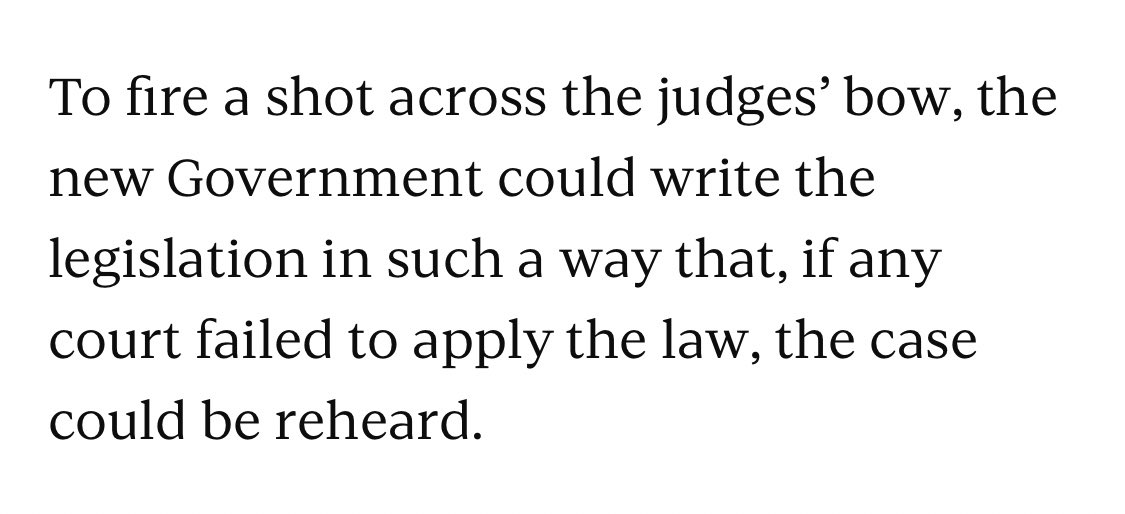
It couldn’t have come at a worse time. We’re all too tired right now to be doing culture wars in the appointment of judges, but the paroxysm of coalition negotiations briefly forced it onto our list of things to care about. As if the solution to all our problems was ensuring we don’t appoint any more of these woke judges from Parnell, Herne Bay and Thorndon, instead of prosaic-but-difficult things like increasing legal aid funding, more court staff, and getting the Environment Court to stop using Cambria. Over the three or so days where that seemed possible we had the parties briefing the media to generate articles that included breathless lines like this:

Image

We have that! It’s called an appeal!

A entire year of this criticism of judges discourse is so punishing because the commentariat imagines all judges are Chloe Swarbricks of the bench when in fact all judges are Gerry Brownlees. Or, to put it another way, Chris Finlayson did not spend nine years appointing members of the prison abolitionist movement to the bench.

Anyway, we avoided that crisis. And in words that none of us thought we would ever say, thank goodness for Attorney-General Judith Collins. Talofa, to the new silk. To whom much is given, much is expected, but we know she always gives back double.

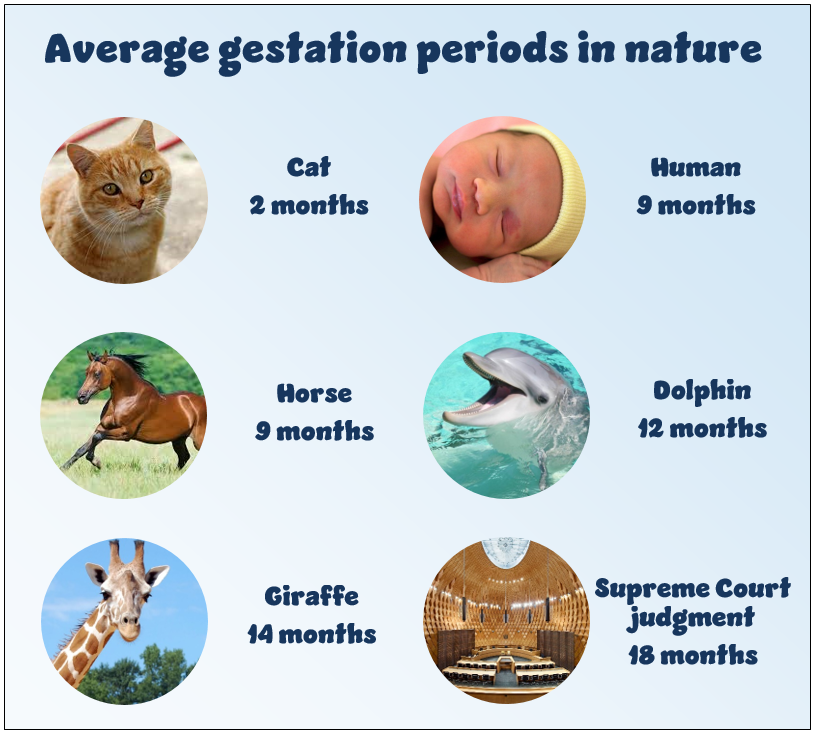
Our Supreme Court didn’t issue another Fitzgerald type bombshell, mainly because these days the Court takes 18 months to issue anything. The appeal decision for Royal Forest and Bird v New Zealand Transport Agency has been reserved for over two years. It’s been so long that we’ve all had to prepare a secret intervention for the judges next February and lure them there on the pretext it’s a conference about 20 years of the Supreme Court.

Image

We got Mainzeal. There is a perennial debate about whether our Supreme Court understands commercial law – an attitude mainly held by people who wouldn’t be satisfied by anything less than the ghost of Ivor Richardson presiding over every case. Let them whine. As Lord Mansfield himself once observed, it doesn’t matter what the rule is, just so long as there is a rule because that way large corporate law firms can do lots of client comms about it. Although, not to criticise, but the judgment seems to have failed to uphold one of the Supreme Court’s key constitutional responsibilities: infuriating Peter Watts KC.

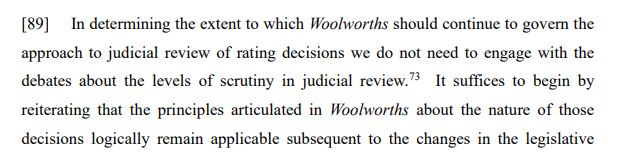
It was the High Court that was the home of mildly subversive rulings this year. We had Parore v Attorney-General [2023] NZHC 1010 awarding legal costs as Baigent damages (although BORA damages have long been a cheque on the executive). We had New Health New Zealand Inc v Director-General of Health [2023] NZHC 3183 that said that review for error of law is mandatory relevant consideration review now for some reason. And when that all got too serious we got James v Luxury Real Estate Ltd [2023] NZHC 1104 to tell us that shouting “fuck [this guy]” at someone wasn’t repudiation of a contract.

Shirt

It’s a year in which I got beaten to within an inch of my life on a long-running difficult case that has been the most difficult of the nine or so years I’ve been doing this. And it’s a year that I’ve done interesting new law things. Both the bad and the good have made me grateful for supportive colleagues all the more. I hope you too have been blessed by the company of friends and loved ones.

Anyway, here are the prizes.

Best headline from 2023

Image

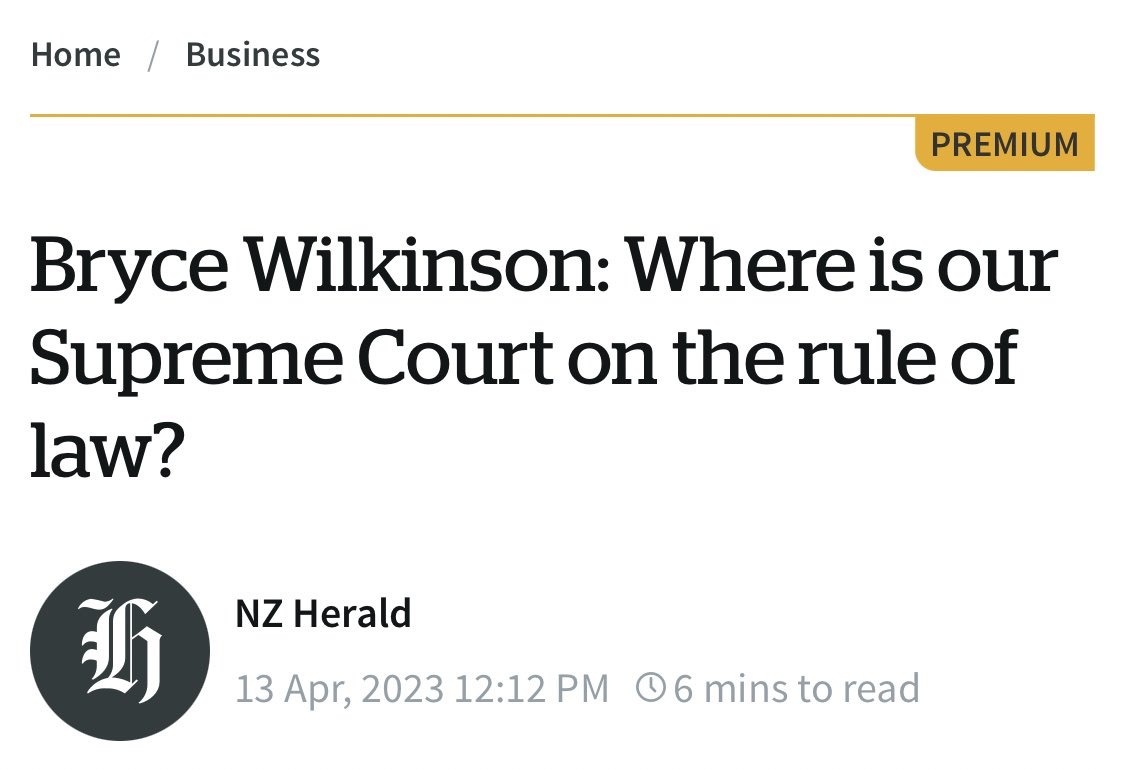
I don’t know, man, I’m pretty sure they’re in favour, eh?

You will recall that this was in peak ramraid angst, where every columnist was calling for the Chief Justice to start personally installing bollards outside Michael Hill Jewellers or else have her Honour’s failure to do so be taken as proof positive that she was boosting Mazda Demios in her spare time. Tawdry stuff.


Best headline from 2003

Image

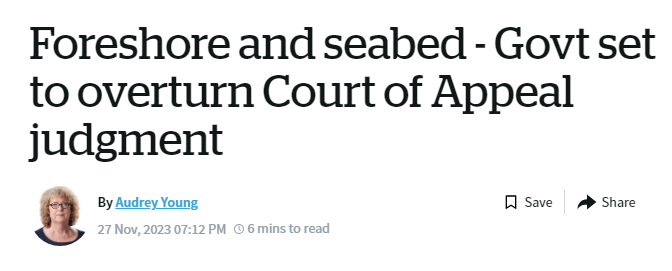
I’m pretty sure I read Ngati Apa in law school and while we all love a good reboot let’s not do this one again.


Worst decision of 2023

This award was conferred at an earlier ceremony.


“I was doing a bit” of the year

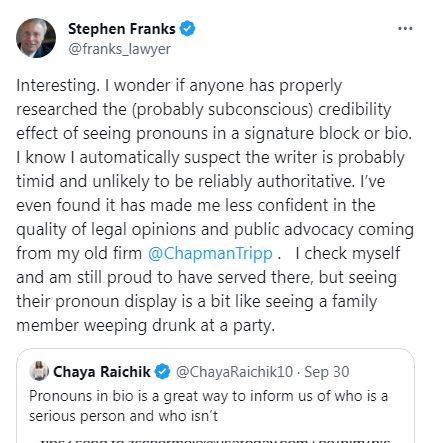
Stephen Franks saying he is less confident in Chapman Tripp legal advice if the writer includes pronouns in the signature block. The thing you have to know about eye-wateringly expensive, 150 year old, gigantic corporate law firm Chapman Tripp, named after one of colonial NZ’s powerful legal dynastic families, and lawyers to most extractive industry in the country, is that it’s woke.

capture


Best joke that wasn’t appreciated by any of you ungrateful bastards of the year

Fraud

It’s because fraud unravels everyth- You know what? Never mind.


Opinion piece of the year

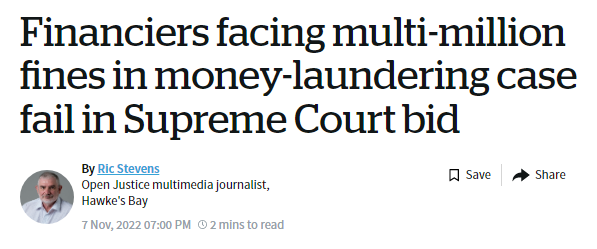
The Treaty of Waitangi gave me a papercut, by Gary Judd KC. Published by ADLS LawNews.


Best actor with general appeal

Image


Court of the year

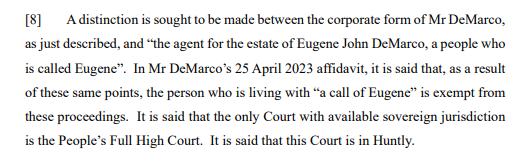
Jointly awarded between the People’s Full High Court in Huntly:

Image

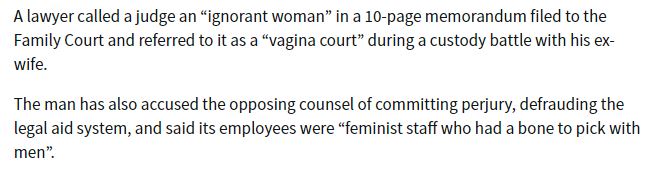
And the Vagina Court:

Vagina court


Tween birthday party disinvitation of the year

The ADLS Criminal Law Committee’s letter to the Minister of Justice saying that:

Invitations have been sent out in your name for an event at Parliament to launch a book authored by Professor Elisabeth McDonald, titled, “Intimate partner rape and the trial process: Research, reflections and reform”. It is likely that this book continues the author’s campaign for major changes to the conduct of rape trials.

It is the strongly held view of ADLS Criminal Law Committee that Professor McDonald’s work has harmfully influenced the legal landscape – to the detriment of those the law is actually required to presume innocent – and we suggest that her influence should not be further lauded.

Professor McDonald was one of the personalities behind the draconian ‘reform’ to remove the long-established right of defendants to lead relevant evidence as to sexual practices between the defendant and the complainant, within their prior relationship. That ‘achievement’ was enacted via the Sexual Violence (Legislation) Act 2021. Moreover, during her select committee appearance on the bill, Professor McDonald made comments that are reasonably interpreted as supporting the enactment of further circumscriptions as to even mentioning during trial, the prior relationship between the complainant and the defendant. I must let you know that the Defence Bar, will be implacably opposed to any further ‘reform’ along this track.

The whole thing is so great, by which I mean dreadful.

It would probably assist the profession if the Committee  could state for the public record any other academics whose work ADLS (now The Law Association) considers has harmfully influenced the legal landscape to the detriment of those presumed innocent. That would let us all avoid inadvertent further lauding so that the Criminal Law Committee may in future focus on its policy work and advocacy for members.

If The Law Association will continue to single out academics, please could I suggest Sir John Salmond who taught in Australia from 1897 to 1906 and for that reason should be considered suspect.


Conference fee of the year

Image

$2,799 for a conference? On current Baigent damages awards you would have to be unlawfully detained for eight and a half days in order to be awarded sufficient money to pay for a conference ticket. For $2,799 I want a conference goodie bag and a drinks function hosted on Arnold J’s yacht.


Blog comment of the year

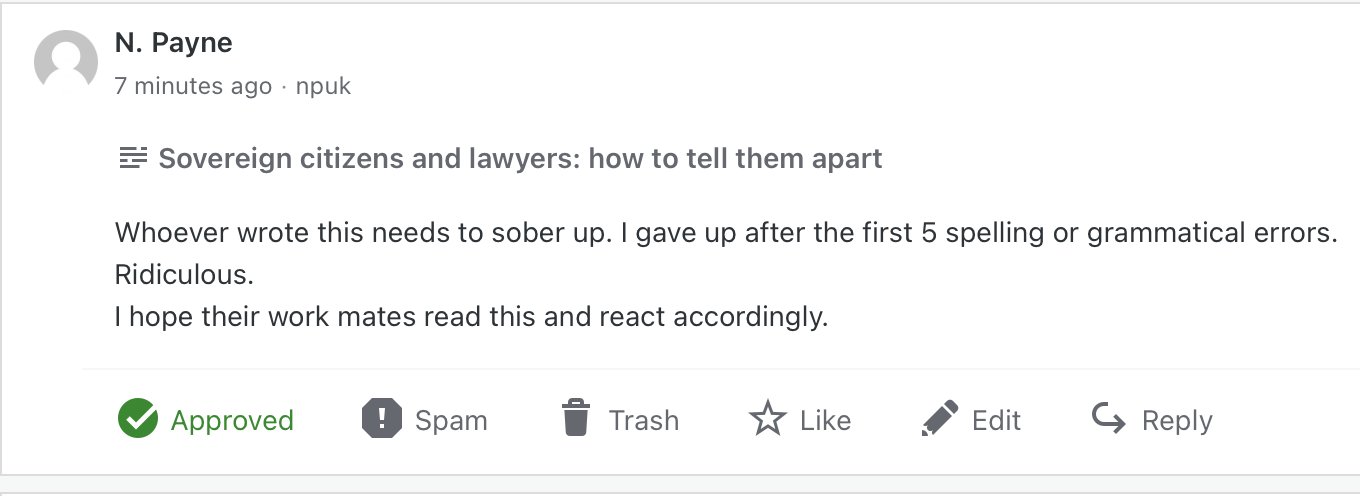
I didn’t write much this year, but I very much enjoyed this comment:

Image


The Golden 30 Foot Bargepole (awarded for best avoidance)

Awarded to the Supreme Court for once again declining to engage with the intensity of judicial review in Auckland Council v CP Group Ltd [2023] NZSC 53. Court-watchers will know that it is one of the Supreme Court’s longest standing precedents that it won’t say anything about intensity, and the Court boldly applied that approach here in what was at least a triumph for stare decisis.

CP Group


Special Achievements in Interpretation

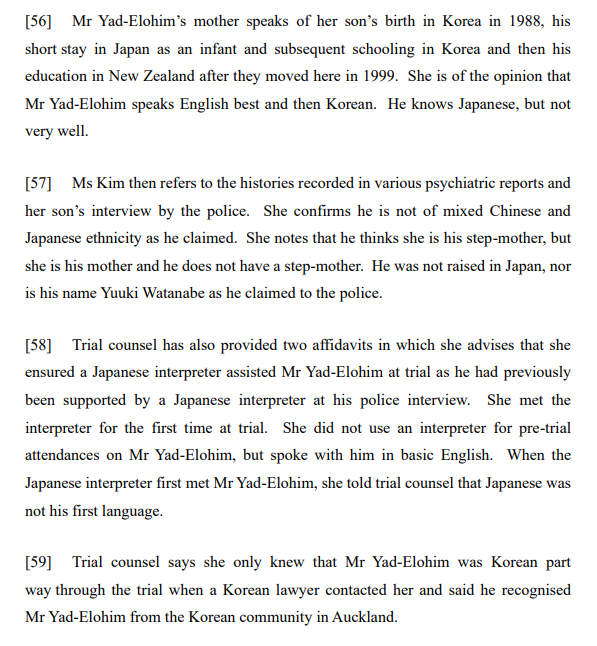
You know when the state put a man on trial for murder and he said he was Japanese and we gave him a Japanese interpreter and we got halfway through the trial that also had a Japanese interpreter and then defence counsel found out that he only thought he was Japanese and even then only because someone from the Korean-New Zealand community contacted him to say “hey I saw this on the news and that dude is Korean”? No? Well that’s what happened, as recorded in Yad-Elohim v R [2023] NZCA 136

Image


Euphemism of the year

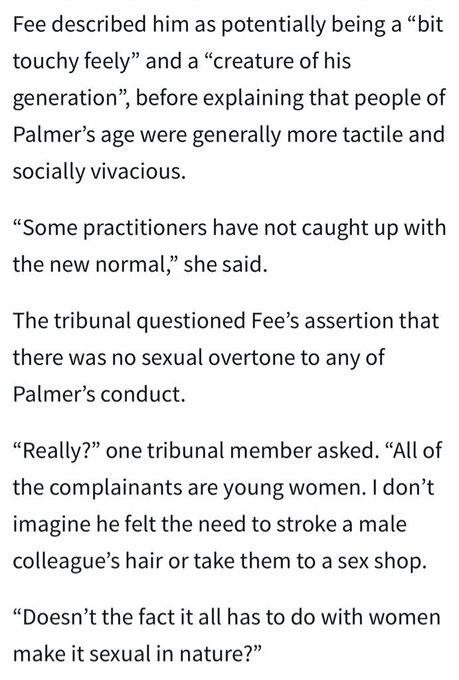
You had to read it at the time. You’re going to have to read it again now. Yes, misbehaving lawyers are just “tactile and socially vivacious”. Sick bags provided on request.

Image


Quote of the year (tangentially law-related)

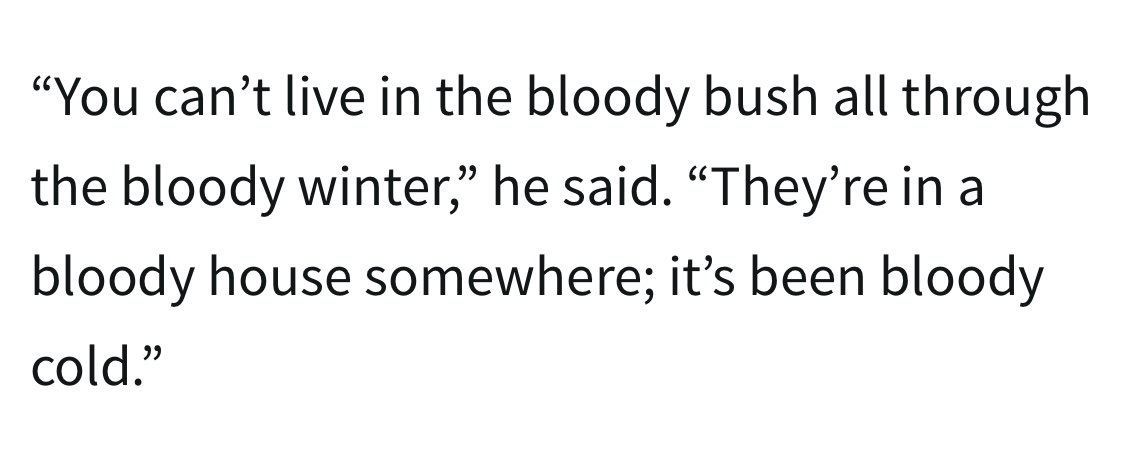
A Marokopa local quoted by the Herald on the missing Tom Phillips (erstwhile alleged bank robber) and his children. 

Image


Feel-good planned terror attack of the year

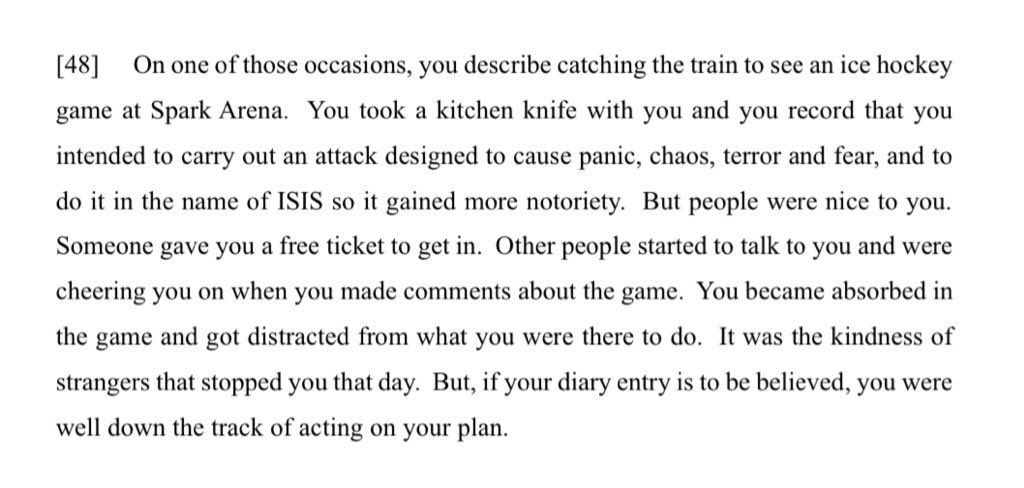
This from R v G [2023] NZHC 434 as a reminder of the importance of kindness in all things. 

Image


Daftest thing I’ve read all year

Remember the Supreme Court decision in Moncrief-Spittle v Regional Facilities Auckland Ltd [2023] NZSC 20? That was the one that said that cancelling the venue booking for Lauren Southern and Stefan Molyneux was a demonstrably justified limit on freedom of expression, essentially because there was going to be a gigantic mob of people protesting and counter-protesting outside the Bruce Mason Centre and there was no way to keep people safe. 

Well, the Free Speech Union drafted a bill that would prevent that from happening again. Yes, we thought we left the term “heckler’s veto” behind in 2022 but it follows us still. 

The bill, which you can read here, includes a cl 3(a)(iv) that would prohibit organisations from taking into account health and safety responsibilities in deciding whether to host speakers. Then cl 5(a) would exempt them from prosecution under the Health and Safety at Work Act 2015. I don’t know what the answer is to difficult questions of free speech, but I don’t think it’s “commit crimes”.


That’s all I have. See you next year where we’ll all be doing and judicially undoing three strikes again. Rest up. It’s going to be busy.

A pod of killer whales off the coast of Spain keeps attacking s 4 of the Bill of Rights Act

Orcas

A pod of orcas off the coast of Spain has started attacking s 4 of the New Zealand Bill of Rights Act 1990 in a spate of episodes that has experts concerned.

Since 2020, the group of five or six black and white aquatic mammals has issued judgments that have left s 4 shaken and taking on water.

The string of incidents has left whale experts confused and constitutional scholars concerned.

“Orcas are very social creatures,” explained marine biologist Alfredo López Fernandez, a biologist at the University of Aveiro in Portugal. “We often see group behaviour that can include interactions with boats or what we interpret as play. But for them to be issuing 50 page written judgments about a key piece of New Zealand’s constitutional arrangements is something we’ve only started to see in the last couple of years.”

Constitutional scholar Dr Edward Willis told RNZ: “Of course, whales are not part of New Zealand’s hierarchy of courts so what they have written isn’t binding. However, if the orcas doing this turned out to be some sort of apex court for whales then it is possible that what they have to say would be of persuasive value when our own courts consider these issues.”

Researchers aren’t sure why the orcas are going after the legal principle but there are two hypotheses. The first is that this is a new fad among orca. Researchers have previously observed trends in orca populations that seem to come and go. The second is that this is a reaction to traumatic incidents involving other sections of New Zealand legislation. Scientists theorise that the orcas have come to associate lawfully enacted Acts of Parliament as a sort of threat and that the judgments are a response.

The whales’ written reasons, which seem to be becoming more frequent and intense in nature, have caused significant damage to s 4, which ordinarily prohibits courts from declining to apply any enactment by reason only that the provision is inconsistent with the Bill of Rights Act. Large parts of the wording have been slammed repeatedly and significant portions of the rights instrument are listing to one side.

Efforts to explain to the whales that s 4 is binding on constitutional actors within a legal system founded on Parliamentary sovereignty have been unsuccessful to date. Submissions made to the whales on the effect of s 4 have been left rudderless, with several being holed below the waterline.

“There was one orca that we seemed to be able to get through to,” explained López Fernandez. That was an older whale known to researchers as Free Willie. “However, he seems to have left the pod and his efforts to dissuade the others don’t appear to have been successful.”

A spokesperson for the Attorney-General said that the government was aware of the whales’ judgments. A New Zealand navy frigate – the HMNZS Chisnall – had been dispatched to the North Atlantic to monitor the situation.

A plea for medium-term consequences

The worst High Court decision of 2023 is called Ngāti Paoa Trust Board v Panel Convener [2023] NZHC 1328.

The COVID-19 Recovery (Fast-track Consenting) Act 2020 provides for expert consenting panels. Expert consenting panels decide resource consents for specified projects on fast-forward. An expert consenting panel “is administrative and quasi-judicial in nature and its practical purpose is to replace both the consenting authority and the Environment Court roles” (at [53]).

The Act tells the Minister to appoint a current or former Environment Court Judge to be the panel convener. The panel convener’s job is to appoint panel members. Local authorities and iwi authorities may nominate people for appointment, and the panel convener can appoint others as well.

Unsurprisingly, there are statutory criteria for appointment. Collectively a panel must have knowledge, skills, and expertise relevant to resource management issues; the technical expertise relevant to the project; and expertise in tikanga Māori and mātauranga Māori.

The panel convener is retired Judge Newhook.

Judge Newhook went to appoint an expert consenting panel for the Botanic Riverhead consent. Ngāti Paoa Trust Board nominated James Gardner-Hopkins. Mr Gardner-Hopkins’ name and actions will be familiar to you. He is not the focus of this post; the High Court judgment is.

After some correspondence, Judge Newhook declined to appoint him to the panel. Judge Newhook’s reasons were:

[21] I have come to the conclusion that acting reasonably and in good faith, I may also take into account other considerations than a person’s ability to perform the functions of office, because those extend to other factors relevant to participants and the broader public having confidence in the consenting process and the outcome, as well as in the decisions of the panel [convener] concerning the appointment of panel members.

[22] This includes that a person’s character and integrity is relevant to whether that person can perform the functions of office, and can be confidently perceived by parties and the public generally to be able to offer that.

[23] Because of the matters quoted from the High Court decision above, my conclusions in the immediately preceding paragraphs, and to a degree in the context of judicial comity with the decisions of the Tribunal, the High Court and the Environment Court cited above, I have decided to decline the appointment of James Gardner-Hopkins nominated by [the Trust] for this decision-making panel.

The Ngāti Paoa Trust Board applied for judicial review.

In the High Court, Churchman J declined the Board’s first ground of review relating to Judge Newhook’s power to say no. That turned on statutory interpretation. The Act did not require Judge Newhook to appoint a person where they were the only person nominated by an iwi authority. And Judge Newhook retained a “discretion not to appoint a particular person to a panel for factors outside of the prescriptive requirements [of the Act]” (at [58]).  That was an implied ancillary power in the statute.

But Churchman J upheld the Board’s second ground of challenge. Judge Newhook took into account irrelevant considerations in exercising that power. Justice Churchman considered two aspects to this.

First, Judge Newhook was wrong to consider that “judicial comity” was a reason to decline to appoint Mr Gardner-Hopkins. That was essentially founded on the basis that the Disciplinary Tribunal and High Court decisions suspended him from being a lawyer.

Previously, the Environment Court had concluded that letting Mr Gardner-Hopkins appear as a non-legal representative in court proceedings, while suspended from practice, would cause people to question what effect the Environment Court was giving to the Tribunal’s suspension order: Port of Tauranga Ltd v Bay of Plenty Regional Council [2022] NZEnvC 92. Comity spoke against him acting as a representative.

Judge Newhook had taken a similar view about his appointment to the expert consenting panel.

Justice Churchman was critical:

[87] … The application in the Port of Tauranga decision, if it had been successful, would have involved Mr Gardner-Hopkins appearing before a Court and acting as an advocate for, or otherwise representing, a party at Court hearings. This is different from acting as an expert panel member determining resource consent applications on their merits. I am satisfied the Port of Tauranga decision does not preclude the appointment of Mr Gardner-Hopkins to roles which do not involve fundamental incidents of legal practice such as representation and advocacy.

[88] In reaching this conclusion, I do not disagree with any of the reasoning in the decision in Port of Tauranga. I have found that the role of being a panel member is different to the role of being an advocate in a Court and is the type of work in the resource management area that the Disciplinary Tribunal expressly anticipated that Mr Gardner-Hopkins may be able to undertake during the period that he was disqualified from practising law. Judicial comity did not therefore require the Convener to decline Mr Gardner-Hopkins’ nomination, and the Convener erred to the extent he made his decision on the basis of the need for judicial comity.

But that’s not an error Judge Newhook made. He didn’t identify any need for judicial comity. He didn’t say that judicial comity required him to decline Mr Gardner-Hopkins’ nomination. He simply said his decision was “to a degree in the context of judicial comity with the decisions of the Tribunal, the High Court and the Environment Court”. In context, that is saying nothing more than the Tribunal, High Court and Environment Court decisions have commented on Mr Gardner-Hopkins’ integrity, and the public perception of letting him be involved in legal processes while his suspension is on foot.

That is absolutely something that Judge Newhook can take into account. You know how I know? Because Churchman J said it 23 paragraphs earlier:

[65] … It would be inconsistent with the purpose of the Act if a convener lacked discretion to decline a nomination even in situations involving clear evidence that a nominee would bring the panel, process and outcomes of the fast-track consenting process into disrepute and therefore lacked capacity to hold office in the terms described in Clark v Vanstone. Such an outcome would be contrary to the purpose, function and public nature of the consenting panel process.

Nor is Churchman J’s reasoning convincing when it says that Mr Gardner-Hopkins’ suspension should only restrict his appointment to roles that require him to represent someone or advocate. First, the expert consenting panel is quasi-judicial. That necessarily invokes the scrutiny of standing in the legal community. Appointment to a panel designed to partly replace the Environment Court sure seems like something we ought not to appoint disgraced lawyers to. What do the lawyers submitting on applications to the expert consenting panel feel about making submissions to a suspended colleague? Second, where did Mr Gardner-Hopkins get his expertise in resource management law? Could it be from his years of practice from being a resource management lawyer? On Churchman J’s analysis, regulatory authorities including the High Court of New Zealand have determined that Mr Gardner-Hopkins ought not to be afforded the privilege of acting as a resource management lawyer, but it is wrong to even take this into account when deciding whether he can be appointed to a state-funded position about resource management law.

The second aspect of irrelevant consideration review that Churchman J upheld relates to the assessment of Mr Gardner-Hopkins’ “character and integrity” (at [89]). His Honour held:

[89] … I do not consider that Mr Gardner-Hopkins’ suspension from legal practice (and the reasons for it) was a factor which should have been material in the Convener’s decision declining his nomination, as it clearly was.

Pause there. That’s not relevant considerations review. If Judge Newhook could lawfully consider the matter (and Churchman J accepts he could), then after that weight is a matter for Judge Newhook unless the decision became unreasonable in a public law sense. The High Court cannot review a decision-maker for the degree of materiality they placed on a relevant consideration.

His Honour continues:

[91] I consider that to prevent Mr Gardner-Hopkins from assuming roles outside those performed in a legal capacity on the basis solely of his suspension from such practice would be to punish him again for the same misconduct, which has already been fully dealt with in his suspension from legal practice, and in fact cut across the finality of the Tribunal and High Court decisions and orders.

The characterisation of “punishment” is not helpful. A Tribunal decision suspending one from practice for non-consensual touching of junior lawyers is not a clean slate mechanism. The suspension from practice means that he can’t be suspended again for the same thing. It doesn’t prevent people making judgements about his character. To test this reasoning, ask the question, could his conduct be considered as part of a decision whether to appoint him as a High Court Judge? Obviously, instinctively, yes! So it hasn’t been “fully dealt with” as Churchman J puts it. Because what we’re really relying on is the underlying conduct that the Tribunal and High Court have identified and publicly condemned.

And even if simply taking into account previous conduct as a reason to decline appointment was a “punishment”, how about we finish the first punishment before we decide whether something is punishing someone again? Here, Mr Gardner-Hopkins has not even served half of his three year suspension. The chance of rain is not unreasonable while you remain under a cloud.

Justice Churchman concluded:

[94] I consider that the Convener erred to the extent that he focused on past events and misconduct rather than the nominee’s ability to perform the role without bringing the panel into disrepute. Given the public censure in the form of the suspension from legal practice, the interventions in which the nominee had subsequently engaged, and the fact Mr Gardner-Hopkins has been held to account for his actions in receiving the maximum suspension from legal practice (short of being struck off), the risk of Mr Gardner-Hopkins bringing the panel into disrepute in the eyes of someone fully informed of the detail of the Tribunal decision is not a matter that justified the Convener’s decision.

[95] Accordingly, I consider the Convener erred in declining Mr Gardner-Hopkins’ nomination to the panel on the grounds stated. While the Convener was correct to note that he was entitled to take other considerations into account in determining whether to appoint Mr Gardner-Hopkins to the Panel, nothing in the Tribunal, High Court or Environment Court decisions required him to decline Mr Gardner-Hopkins’ nomination, nor indeed gave any good grounds to do so.

I think it’s that last sentence that prompted me to write this. Are there really no good grounds in the Tribunal and High Court decisions to decline to appoint Mr Gardner-Hopkins? Is there no obstacle to appointing a person to a position of power, no obstacle whatsoever, if that person has demonstrably abused a position of power in the past? Is it really the case that Mr Gardner-Hopkins has been “held to account for his actions” when he has not yet even served half of his suspension? Because that is what the High Court of New Zealand is saying in that last sentence. That is far more than a court needed to go on judicial review, but Churchman J chose to say this. And it’s deeply, deeply depressing.

Rehabilitation is possible. The Tribunal decision and the High Court decision record contrition on Mr Gardner-Hopkins’ part. There will come a day when he returns to the profession and he can look us in the eye. But, as I said near the start, he is not the focus of this post; the High Court judgment is.

I am not asking for eternal punishment but, damn it all, some medium-term consequences would be nice. I refuse to accept that we can be in moving on, forward-looking territory when a practitioner has not yet at least finished serving their penalty and we’re contemplating their appointment to a state-funded quasi-judicial panel.

Justice Churchman pointed several times to the Tribunal decision and what it said about not intending to prevent Mr Gardner-Hopkins making the most of his skills in resource management. I’m not quite sure what the Tribunal would have made of this one. But that’s not the paragraph in the Tribunal’s decision that should cause us to reflect. It’s this one:

[185] We wish to comment briefly on the effects on the complainants, and the other two (then) junior women lawyers who gave evidence. Of the group, two have left New Zealand – one specifically as a result of these events; at least one has left the profession; another changed her area of practice so as to avoid contact with Mr Gardner-Hopkins (especially after he was elected President of the Resource Management Lawyers Association); another felt her career had been adversely affected. It is a mark of shame for the profession that its most junior members have shouldered the burden of bringing these events to notice, but it reflects only positively on them.

One of Mr Gardner-Hopkins’ victims left resource management law after he was appointed to a position of power and responsibility in the area. The response of the High Court to his prospective appointment to another position of power and responsibility in the same area is to say that nothing he had done “gave any good grounds” to refuse him. More than that, the High Court ventured that “someone fully informed of the detail of the Tribunal decision” would conclude the same (at [94]). Consider me uninformed.

I don’t know if Mr Gardner-Hopkins will get to sit on an expert consenting panel. It’s not clear that Judge Newhook will have to make a fresh decision since he has already appointed other people. And expert consenting panels will cease to exist when the legislation auto-repeals in a month or two anyway.

But the pass that the High Court has given this episode leaves me thinking about the last six years. Is this going to be the profession’s response? You can’t keep a good man down, they say. But actually it turns out you can’t keep any man down. One free bauble of office for everyone who makes it halfway through their suspension. Expert consenting panels filled with people whose expertise in consent is deeply, deeply ironic. Mostly, though, I’m thinking I don’t know what the fuck we’ve learned. And that Tribunal paragraph.

Strictly Obiter Law Awards 2022

2022 has been another year of unrelentingly grim challenges for us all: ramraids, violent protests at Parliament, more Covid cases than ever, a cost of living crisis, Capital Letter editorials. And, while there is still a month to go in this year, there is not a lot left in the tank of this tired hack. Time to start wrapping things up. 

It has been another tough year for the judiciary who continued to be accused of supporting a tyrannical government oblivious to human rights, at least so far as the Covid response goes. The irony being that as soon as a New Zealand judge actually does support a tyrannical regime their conscience tells them to quit after less than a fortnight in the role. Still, grim to reflect on the hard times judges have for retirement jobs these days. Robin Cooke went to the House of Lords. Thomas Gault became the captain of the Royal and Ancient Golf Club of St Andrews in Scotland. All William Young J could get was a part-time gig as a velvet glove to some iron fisted despots running an international arbitration centre, and he beat the Lowell Goddard shortest-time-in-role record by some months. None of this would happen if Stephen Mills KC was allowed to take judges sailing again.

In the workplace the trend of the year has been Quiet Quitting, which is when you resign your judicial warrant before the Judicial Conduct Commissioner can say anything. In the big firms there are about three solicitors with 4 years PQE left in the entire country. The rest are in the UK. (ARD and LXL – if you’re reading this, come back!)

We’ve had Make It 16, and Fitzgerald v Attorney-General and the Chisnall hearing. I think 2022 is what the 1990s must have been like. Every day you wake up and the Bill of Rights Act is being used in new and exciting ways. And also there’s a Cooke, Ellis, Gault, Thomas and Goddard on the bench. (To be clear, I was alive in the 1990s but East Taieri Preschool didn’t have a subscription to the NZLRs.)

Activism

Our Supreme Court has had to put up with the commentariat calling them judicial activists. This must come as a surprise to the judges – a group of people in their 50s and 60s with knighthoods and state pensions, who divide their time between the bench and the Koru Lounge. Even I – a perpetual disappointee when it comes to Supreme Court decisions – think that we can do better than throwing the old judicial activism label around. After all, you go to the Court of Appeal for error correction; you go to the Supreme Court for era correction. And while it’s true that recently the only thing surprising about a constitutional orthodoxy is that an appellate court has chosen to adhere to it, I would still like to see an improvement in the quality of our complaining about the Supreme Court in 2023. I will be auditing this.

Anti-mandate protesters at Parliament didn’t succeed in erecting a scaffold in front of the Court of Appeal but they did throw up a block of toilets. There’s a metaphor in there probably. Still, the Court of Appeal came through it okay despite being in the centre of the protests. Court of Appeal judges have long experience in ignoring  people who appear in front of them to make outlandish demands. The scaffold came later in the year; Cooper P succeeding where the protesters failed.

Scaffold

For more of Cooper P’s achievements you might like to read this.

Queen’s Counsel became King’s Counsel on the death of the Queen. Most of the rest of the legal system will carry on the same. For example, a change in monarchs won’t alter how serious crime is prosecuted. Most will be done by King Charles’ Crown Solicitors, and the rest will be done by King Charles’ panels. And that’s the only joke I have about that, except this photo:

Taskmaster 


Time to hand out the gongs. Remember, one Strictly Obiter Law Award is worth three New Zealand Law Awards and is equivalent to a top ten ranking in the Lawfuel Power List.

Best root and branch reform of the year

CJ Tree

Sometimes you just need some good old-fashioned constitutional spadework.


Air New Zealand Safety Video Award for Best Legal Procedure

The Judicial Conduct Commissioner and Judicial Conduct Panel Act 2004. In the event of a judicial conduct investigation, emergency escape path lighting will guide you to the nearest exit. 

Two different judicial officers quit this year, scuppering a judicial conduct panel and a JCC investigation. It leaves us no wiser about judicial (mis)conduct in two incidents that were significant enough to warrant resignations. Our judicial system as the same level of accountability as I have when I sneak a third gingernut at supper. It’s not that judicial conduct panels are powerless to do something; it’s that they’re powerless to do anything.


The Freedom Costs A Buck Oh-Five Award

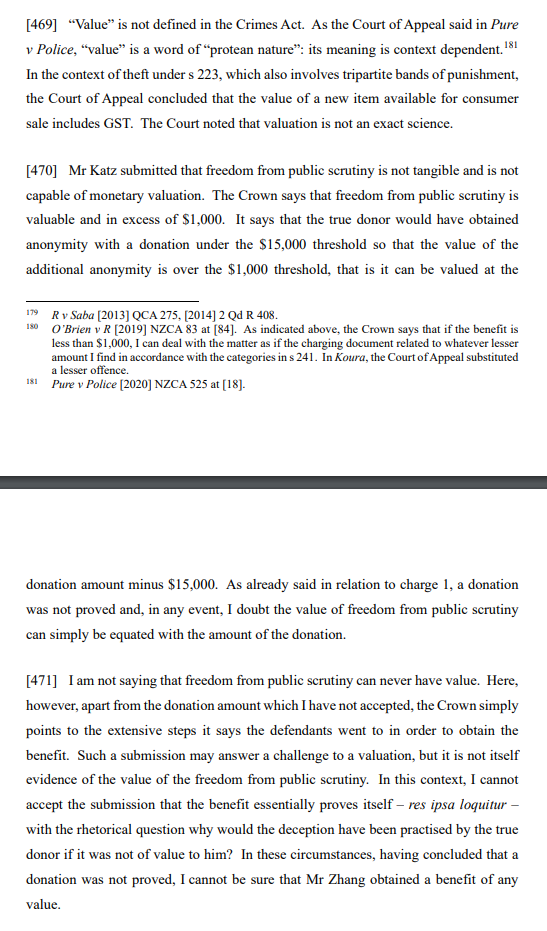
The Serious Fraud Office. They say you can’t put a price on privacy, but that didn’t stop the Crown from trying in the election donations trial. Having charged the defendants with obtaining a benefit by deception, the Crown needed to prove what that benefit was, and that it was worth over $1,000. One limb of the Crown’s case was that the benefit was “freedom from scrutiny”. But what’s that worth? Gault J says not provably more than $1000 in this excerpt from R v Zhang [2022] NZHC 2541:

Value

Still, it’s good news for anyone who succeeds in establishing a privacy breach by the SFO in the future. You can cite this decision as agreement by the SFO that your privacy was worth at least $1000. 


Judicial photo of the year that is not the Chief Justice and Minister of Justice planting a tree

Goddard1

Yes, it’s Goddard J in a virtual reality headset. The Member of Parliament for Molesworth Street visited the National University of Singapore. Technology under development there will enable Court of Appeal judges to better understand District Court practice. 


Law reform of the year

Occasionally, very occasionally, having a good old moan on Twitter can achieve something. 

Prescott1

That (and a few more tweets on the subject) were sent off into the ether. Then, six days later, a new Court of Appeal Civil Practice Note appeared, with a new clause inserted. 

PN

A little bit post hoc ergo propter hoc here. But I’m claiming it as a win! The system works!


Euphemism of the year

The reason given for the withdrawal of legislation to reform journalistic source protection: “insurmountable drafting issues“. Since then, this has been my go-to excuse whenever my bosses chase work from me. 


Strenuous denial of the year

Marc Corlett KC giving the defence opening statement in the election donations trial. This was a judge-alone trial! If this had to be elevated for a jury it would have blown out the windows in the courtroom.

As reported by The Spinoff:

Marc Corlett QC, who is acting for the man who purchased the paintings related to the Labour donations case, said the SFO case appeared to have been “reverse-engineered to meet a preconceived investigative assumption that there must be a parallel ‘structure’ between the Labour Party and National Party cases”. The prosecution, he said, was asking the court to “draw inferences … that cannot be drawn without rabid speculation and a disregard of the burden of proof and the presumption of innocence”. The case against his client, he contended, was “the product of a fertile investigative imagination which has harnessed the innocuous and ridden the high horse of confirmation bias to a land of fantastical conclusion”.

The case, Corlett continued, was “a theory in search of evidence … animated by predetermination, fuelled by speculation, and dependent on some Eurocentric, cringe-inducing cultural assumptions.” He pledged that the substantive trial meant “it no longer suffices for the Crown to throw up fairy dust and say – ‘see, this evidence is consistent with our fertile imagination of what [the suppressed defendant] might have done’”. 


Judicial photo of the year that is not the Chief Justice and Minister of Justice planting a tree or Goddard J wearing a VR headset

Peoples Court

You can’t tell me this guy doesn’t run the 2.15pm sentencing list in Invercargill District Court. This bloke has presided over more livestreamed trials this year than every High Court judge combined. More likely to be subject to an adverse finding by a judicial conduct panel than a real judge. 


New human right of the year

A big year for rights discourse. As s 28 of the New Zealand Bill of Rights Act 1990 reminds us: “An existing right or freedom shall not be held to be abrogated or restricted by reason only that the right or freedom is not included in this Bill of Rights or is included only in part.”

Taking that message to heart was an anti-mandate protester arrested at a Rotorua restaurant, as reported by the New Zealand Herald:

Human right

As Desmond Tutu once said, “I am not interested in picking up crumbs of compassion thrown from the table of someone who considers himself my master. I want the full menu of rights.”


Law Firm That Most Sounds Like Something From The Edmonds Cookbook Circa 1950

Woodward Chrisp


The “Law Is Just Common Sense, Really” Medal

Pere v Attorney-General [2022] NZHC 1069, [2022] 2 NZLR 725 for “establishing” that being shot in the back while detained in Police custody breaches the detainee’s right to be “treated with humanity and with respect for the inherent dignity of the person”.


Triumph of monism over dualism of the year

The Freedom and Rights Coalition’s People’s Court. A movement virulently against the strawman of United Nations control purported oversee the direct domestic application of an International Criminal Court trial in the grounds of Parliament. 


Sovereign citizen of the year

Connor the Dog. In James v District Court at Whanganui [2022] NZHC 2196 a Sovereign citizen argued that his dog was a Sovereign citizen. 

Connor

For more on Sovereign citizens you might like to read this piece.


Supreme Court decision of the year

Harding and Berkland v R.

We’re being told that Harding and Berkland v R couldn’t be here due to insurmountable drafting issues, so to accept the award on its behalf is Attorney-General v Family First


Twitter civil war of the year

Lecture recordings! Were you on the side of the coddled and the lazy, who would miss out on the benefits of coming to campus? Or were you on the side of the heartless and out of touch, with no idea of the pressures of modern life? Either way, you were in the wrong. Grim times for us all. Olive branches were fashioned into sharpened stakes. The uneasy truce holds to this day, but only because we’ve all agreed not to speak about it any more. 


Worst legal argument of the year

Business New Zealand. Business NZ makes a complaint to the International Labour Organisation about the Fair Pay Agreement Bill. Then Business NZ publishes a document that says New Zealand is on a list of the worst case breaches of international labour treaties. Except…

Business

Just absolutely terrible. Real “only read the headnote” stuff. 


Judicial diversity award

Having a High Court bench made up from people of all backgrounds is important. They bring their own life experiences to the important business of judging. Like this in R v Fakaosilea [2022] NZHC 2984, where Campbell J knows that it’s possible to buy several ounces of cocaine in a few hours.

Diversity


May you survive until the end of year break, and may all your reserved judgments be delivered before Christmas. 


Can you identify the Supreme Court of New Zealand from these headlines?

Ten headlines. Can you tell which ones are about the Supreme Court of New Zealand?


Question 1

SC1

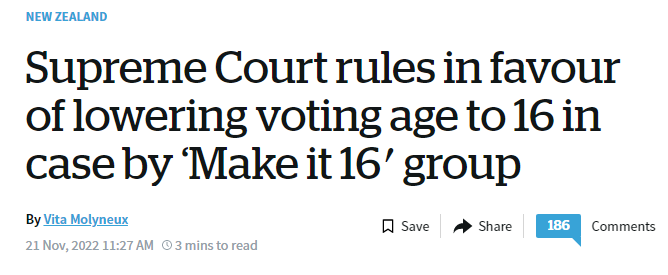
Answer: This one is about the Supreme Court. There were a few clues here. “Make It 16” is a recent Supreme Court decision, and the headline in fact uses the words “Supreme Court”. 


Question 2

SC2

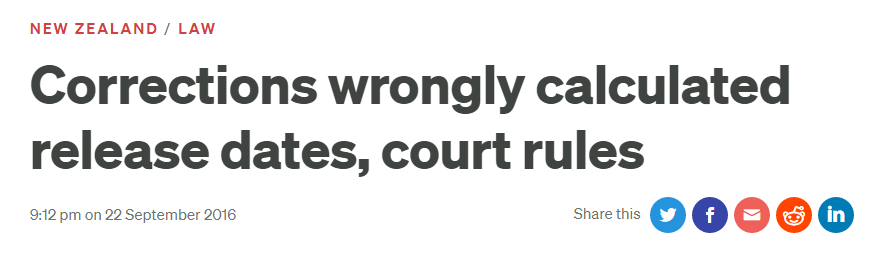
Answer: This one is also about the Supreme Court. Part of the Supreme Court’s role is to “scrutinise” convictions in the context of appeals. The headline also uses the words “Supreme Court”. 


Question 3

Activist1

Answer: This one is not about the Supreme Court. The Supreme Court’s role is to write reasoned judgments explaining their thinking, that is open to critique by any reader. They are not generally required to glue themselves to roads.


Question 4

SC3

Answer: No, this isn’t a trick. Although it refers to only to the “Court”, this is still the Supreme Court. 


Question 5

Activist2

Answer: This one is a trick though. This *isn’t* the Supreme Court. Supreme Court judges have their pensions and the Judicial Conduct Commissioner to think about. 


Question 6

Activist3

Answer: While the Supreme Court sometimes rules against the Crown it does so in accordance with the law and its constitutional role. It does not use cake.


Question 7

Activist4

Answer: It is true that the judges of the Supreme Court are in their 50s and 60s, but we got you again! This is not about the Supreme Court.


Question 8

SC4

Answer: Yes! The Supreme Court! That’s right. We’re laughing, we’re learning. 


Question 9

SC5

Answer: Again, this refers to a ruling by a group of people with knighthoods paid hundreds of thousands of dollars by the state. 


Question 10

Activist5

Answer: Something of a line call, depending on whether you are subject to a civil restraint order or not, but this is not about the Supreme Court.