Desire paths, or, brief thoughts on guideline judgments prompted by Setu v R [2017] NZHC 1839

Desire paths
Local authorities install footpaths in parks, and then find that nobody uses them. Instead, shortcut paths are worn into the grass nearby, indicating where people are actually walking. They are called desire paths.
The Court of Appeal issues guideline judgments for sentencing decisions. They are the paths that counsel and the lower courts are expected to walk when determining starting points in sentencing.
The recent sentencing appeal decision of Setu v R [2017] NZHC 1839 exposed a desire path: a seam of cases all of which were at odds with the numerical guidance in a Court of Appeal guideline judgment. The High Court rejected the appeal and confirmed the primacy of the guideline judgment.
The result is unsurprising (it is a brave High Court judge that would put to one side a Court of Appeal guideline judgment). But I think it raises interesting questions about the validity (in a lay sense) of the Court of Appeal’s guideline judgments. If significant numbers of sentencing decisions are low-balling starting points despite a guideline judgment saying they should be higher, then either we need a new guideline that rejigs the numbers in line with actual practice, or we need a grumpy reminder from the Court of Appeal that sentencing judges need to get with the programme.
In Setu we got something approaching the latter (albeit from the High Court), but I’m not sure it’s enough.
Guideline judgments
(Skip this part if you know what guideline judgments are.)
The Court of Appeal has set guideline judgments for certain types of offences (R v Mako for aggravated robbery, R v Terewi for cannabis offending, R v Fatu for drug offending, R v AM for sexual offending).
The purpose of these decisions is to shortcut sentencing decisions. They offer guides for quantifying sentences based on either examples of types of offending, or the presence of certain features of the offending.
For example, the guideline judgment for grievous bodily harm offending is R v Taueki [2005] 3 NZLR 372, (2005) 21 CRNZ 769 (CA). The Court listed a range of factors at paragraph [31]: things like the use of extreme violence, premeditation, serious injury, the use of weapons, attacking the head, and more.
Then, the Court set out bands containing a range of starting points:
- Band one: 3-6 years’ imprisonment.
- Band two: 5-10 years’ imprisonment.
- Band three: 9-14 years’ imprisonment.
The Court then said that where a certain number of the paragraph [31] factors are present, an offence will fall into a certain band.
Finally, the Court emphasised that the bands should be “used flexibly”, and that “the features of the offending in each case must be carefully assessed in order to establish a starting point which properly reflects the culpability inherent in the offending” (at [42]).
If these guideline judgments didn’t exist, then you would have to find comparator cases in each sentencing decision and, on each occasion, have to analogise a wide range of cases to the particular facts of the instant case. Guideline judgments are intended to bring broad consistency to sentencing decisions.
Setu v R [2017] NZHC 1839
Mr Setu had been sentenced to a total of five years’ imprisonment for a small number of charges, with a lead offence of wounding with intent to cause grievous bodily harm (Crimes Act 1961, s 188(1). Maximum sentence 14 years’ imprisonment). The sentencing judge used the guidance in R v Taueki to place Mr Setu’s offending in the lower end of band three, and took a starting point of 10 years’ imprisonment.
On appeal to the High Court, Mr Setu contended that the starting point was too high because:
- the aggravating features had been double-counted; and
- the starting point was higher than comparable (and more serious) cases.
Justice Mander dismissed the double counting ground and I do not intend to address it.
On the comparable starting point ground, Mr Setu’s counsel pointed to eight comparable decisions all of which, it was submitted, supported a starting point for Mr Setu of no more than eight years’ imprisonment.
Mr Setu’s starting point was therefore:
- in step with the guidance in R v Taueki; but
- out of step with the cases that had applied R v Taueki.
What to do? The answer was a doubling down on R v Taueki. The key paragraphs of Mander J’s decision on this point are below:
[46] Judge Neave was aware in taking a starting point of 10 years that there were sentencing decisions, indeed a majority of cases, where a lesser starting point has been applied. He noted the tension between those cases and the direct application of the Court of Appeal’s Taueki guidance, based upon the presence of identified aggravating features to which Mr Setu’s offending gives rise. A sentencing Judge is entitled to return to first principles and, in particular, to apply the guidance provided by the Court of Appeal when setting a starting point. This is particularly so when over the years since the 2005 Taueki decision, a body of decisions have accumulated which illustrate some variation in sentencing levels and perhaps to some extent “sentence drift” from the original guidance provided by the Court of Appeal.
[47] That development of itself may simply reflect what the Court of Appeal acknowledged in its Taueki decision, namely that sentencing ultimately involves the exercise of discretion and must allow for flexibility. The fact that some sentencing Courts have chosen, as they are entitled, to apply Taueki in a particular way does not, in my view, render another sentencing Court’s application of the Taueki guidance in another case inappropriate, so long as the starting point arrived at can be reconciled with the range the Court of Appeal has held to be available because of the nature and combination of aggravating features.
[48] To suggest otherwise would effectively relegate Taueki to a secondary source of guidance in favour of a requirement that a sentencing Court undertake a comprehensive review of cases, the circumstances of which will almost inevitably vary, before it may confidently impose a sentence for GBH offending. While assistance from other sentencing decisions provides a useful check, such an approach would largely defeat the purpose and utility of the guideline authority.
This is interesting for a number of reasons.
It has implications for sentencing appeals from offending where there is a guideline judgment. It emphasises the primacy of the guideline judgment as the ultimate arbiter of sentence length on appeal, as well as at initial sentence. The test for an excessive sentence should be by reference to the guideline, not by reference to comparable cases. That last sentence is a little over-simplistic as one will still need to check that the aggravating features have been applied correctly (and not, for example, double-counted).
His Honour Mander J did not engage in any substantive way with the eight decisions counsel cited in order to try to distinguish them. Rather, their inconsistency with Mr Setu’s starting point was plainly acknowledged.
I am not sure where that leaves the eight cases that counsel cited. His Honour described them as “applying Taueki in a particular way” and that the judges in those cases were “entitled” to do so. But under Mander J’s approach they are not the first port of call in determining whether a starting point is excessive (Taueki is). They are not really the last port of call either, since Taueki will tell you all you need to know. It’s a neat trick of overruling them without saying they’re wrong: “those decisions are fine, except you don’t need to look at them”.
Back to desire paths
One response to the issues that Setu raises would be to say that the sentencing levels as articulated by the Court of Appeal in Taueki are, on the whole, slightly too high for sentencing judges to stomach. That is why there are so many cases similar to Mr Setu’s but with lower starting points.
In turn, that supports an argument that the local authority should heed the desire path, and the Court of Appeal should reconsider its guideline judgment in respect of the starting points it sets. This would probably best be accomplished by changing the number of aggravating factors that need to be present to get to a particular band. At the moment it is relatively low: you get to band two by having “two or three” aggravating features (Taueki at [38]). This would have the effect of lowering the sentencing levels, without fiddling directly with the years of imprisonment (that’s important because you can’t just lower everything without shying away from the statutory maximum imposed by Parliament).
The alternative is a response along Mander J’s lines: “no. This is the guideline judgment. It is not the appellate courts’ problems if the sentencing courts are lowballing the sentences sometimes.” Or put another way “the desire path is not sanctioned. Even if some people are walking it frequently it doesn’t mean it’s the right way.”
Constitutionally, that is no doubt correct. It also exposes two problems.
First, four of the eight cases that counsel in Setu cited were Court of Appeal decisions confirming or altering the starting point imposed. That means that even the Court of Appeal isn’t consistently applying its own guideline judgment. I think that last sentence is mostly correct. The Court would be reluctant to increase a sentence on appeal so I admit it’s perhaps not particularly fair, but it is correct to say that the Court of Appeal has been signing off decisions that do not necessarily conform to its guideline judgment.
Second and relatedly, it has exposed inconsistent sentencing practice which risks unfairness for prisoners. Parity is jeopardised when a seam of generous sentencing is allowed to pass unchallenged, but comparatively sterner decisions are upheld. An offender in Mr Setu’s position can perhaps feel hard done by that he does not receive a similar starting point in a range of cases that have all purported to apply the guideline judgment.
Sentencing is never going to be a precisely mathematical exercise. All sentences will fall within a range. What matters is that there is one path. A wide path, perhaps, but one path all the same. I think Setu v R shows there is some work to do.
The Supreme Court’s new ceremonial robes
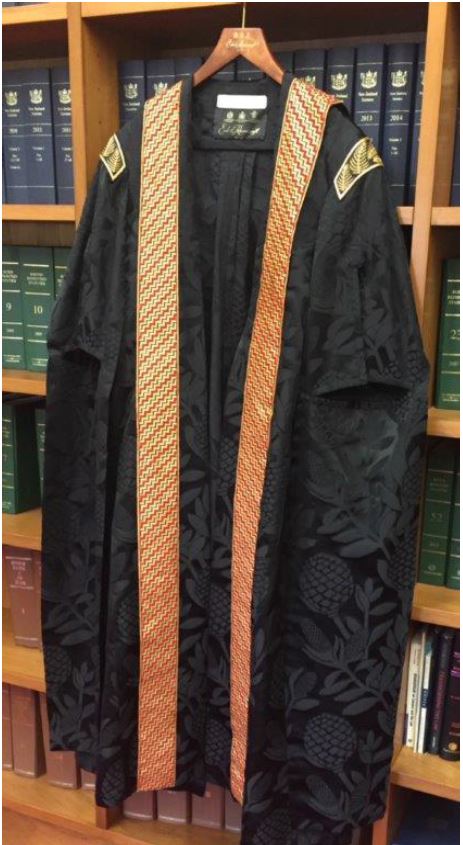
The Supreme Court has issued a press release displaying its new ceremonial robes.
The new robes are the product of a 3-2 split decision (majority Elias CJ and William Young and Ellen France JJ; Glazebrook and O’Regan JJ dissenting).
The shoulder patches are repurposed from All Blacks jerseys belonging to the injuncted 1985 team from the Finnigan case. The trim of the robe is in a pattern of five different colours to symbolise the five different judgments in Vector Gas and Hamed v R, and the robes feature special Lodestar Stichting Stitching.
The fabric is from a couch that the Chief Justice saw in Harvey Norman.
The lyrics of Taylor Swift’s “Love Story” as a unilateral offer in contract law
And I said,
“Romeo, take me somewhere we can be alone
I’ll be waiting, all that’s left to do is run
You’ll be the prince and I’ll be the princess
It’s a love story, baby just say yes.”
Truly this is the Carlill v Carbolic Smoke Ball Co of the late 2000s.
- There is certainty of terms: if the offeree takes the offeror somewhere they can be alone then the offeror will confer the benefits of the title of prince and princess.
- There is the exchange of consideration. The offeror must be taken away, and at pace.
- It is not “mere puffery”. The lyrics make clear: it is a love story, and not a flippant or casual suggestion short of an offer.
- It is capable of acceptance by any person – all they need to do is say yes. However, even this is not necessary as a unilateral contract does not require the communication of acceptance.
- The one possible hiccup is that the offer is not directed to the world at large. Instead, it is addressed to “Romeo”. However, it is possible to interpret the offeror’s “Romeo” as a generic term of address to describe any potential suitor. Any contrary information in the other lyrics that suggest a history with a single individual would be the sort of pre-contractual negotiation that must not be used to interpret the meaning of a contract.
Legal Halloween
- Scare of Children Act 2004
- Haunted House of Lords
- Possession by demonic spirits is nine-tenths of the law
- New Zealand Bill of Frights Act 1990
- Jurisdictional terror
- The man on the Clapham omnibus is following you home
- Trick or invitation to treat
- Severed heads of agreement
- Nightmare on Shortland Street
- The Concept of Law by HLA Hart-ripped-still-beating-from-his-chest
Oh dear. Oh dear. Oh dear.

Woodhouse J on ducks and disorder
Kinney v Police [1971] NZLR 924 (SC)
WOODHOUSE J. The incident giving rise to the charge occurred on 26 October 1970 at the end of a holiday occasion which had attracted a large number of people to the Botanical Gardens at Napier. As he was leaving the Gardens, the appellant stepped barefooted into an ornamental pond and, wading up to his knees, took a few steps in the direction of two mildly interested ducks. “rithin a minute or so he had returned to dry land at the injunction of a nearby police officer, and was thereupon arrested.
The simple question is whether or not his behaviour on the occasion was criminal in the sense contemplated by s 3D of the Police Offences Act 1927. That section is comparatively new. It was introduced into the Act as recently as 1960. It provides that:
“Every person commits an offence … who, in or within view of any public place … behaves in a riotous, offensive, threatening, insulting, or disorderly manner, or uses any threatening, abusive, or insulting words.”
…
The incident which involved the appellant occurred at 5.30 pm. The function was ending and the last of the bands was silent. But as the appellant made his way to the road. he found himself passing the pond which I have mentioned. Normally it is occupied only by goldfish and a few wild ducks, but on this occasion they were joined for a few brief moments by the appellant. The ducks seemed unperturbed – they remained on the surface of the water with scarcely an increase in their rate of stroke. The attitude of the goldfish is unknown. As for bystanders, there were few people about at the time, although there is evidence that. some persons were looking across towards the Gardens from their homes on the far side of the road.
…
In my opinion, the section should not be allowed to scoop up all sorts of minor troubles and it certainly is not designed to enable the police to discipline every irregular or inconvenient, or exhibitionist activity or to put a criminal sanction on over-exuberant behaviour, even when it might be possible to discern a few conventional hands raised in protest or surprise.
As I indicated during the hearing of this short case, it remains open to the local authority to issue an edict in the form of a bylaw regulating the paddling by persons in the City ponds, should so solemn an injunction seem necessary.
Kidnapping with a few extra elements
From the Crimes Act 1908:

Issues with interpreters

Famous movies as written by lawyers
- 500 Days of Summary Judgment
- Finding Nemo Dat
- The Bourne Parliamentary Supremacy
- All The President’s Mens Rea
- Minority Report (starring Elias CJ)
- The English Patent
- Love Contractually
- The Shawshank Ademption
- Close Encounters of the Third Source
- Rebel Without A Cause Of Action
 Strictly obiter