Moot problems what I done wrote

I wrote a bunch of moot problems this year for various groups.  They are posted below and you are welcome to use them with no attribution and free of charge.  I wrote guides for judges for the first two problems, and you can message me on Twitter if you want those.

I have confirmed with the various groups that I can do with them now what I want, including distribute them.  Alternatively, feel free to take the underlying issues and adapt the problems as you see fit.  PDFs should be able to be downloaded at the links below.


NZLS Young Lawyers Mooting Competition moot problem

Issue One: the meaning of “use” in the offence of dishonest use of a document.

Issue Two: the threshold for making enquiries of jury deliberations post-trial under s 76 of the Evidence Act 2006.


Auckland Womens Lawyers Association moot problem

Issue One: whether certain diversion agreements under the Police Adult Diversion Scheme are lawful in light of Osborne v Worksafe New Zealand [2017] NZSC 175 (see also this post).

Issue Two: name suppression following the granting of diversion to a young offender.


University of Auckland LAWS452 Appellate Advocacy practise moot problem

Single issue: when does litigation privilege expire?


University of Auckland LAWS452 Appellate Advocacy assessment moot problem

Issue One: the enforceability of a no-oral-modification clause in light of the UK Supreme Court’s decision in Rock Advertising v MWB Business Exchange Centres Ltd [2018] UKSC 24 (problem predicated on difference in approach between Lord Sumption and Lord Briggs).

Issue Two: whether consideration required for a variation of a contract and whether receipt of a practical benefit is good consideration.

Leave judgment granting appeal direct to Supreme Court.

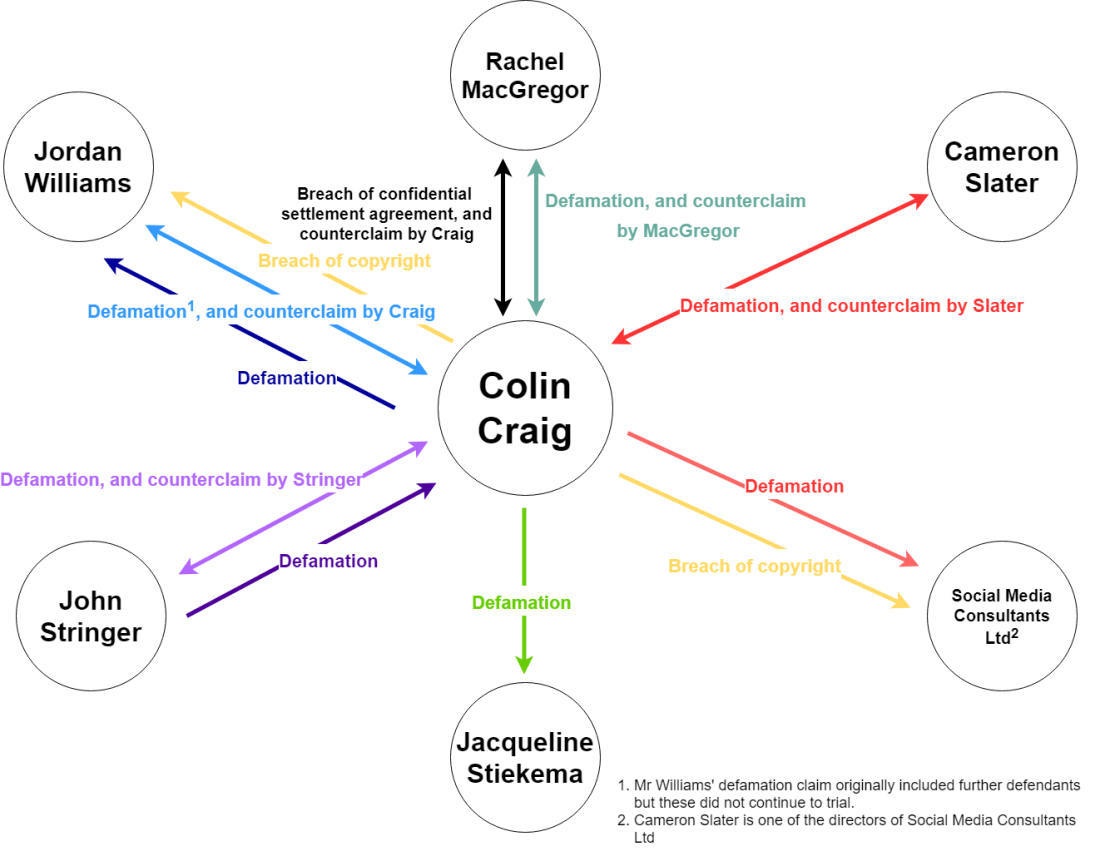
A (perhaps partially) complete list of Colin Craig’s recent litigation

Craig diagram
An alternative diagram can be found here.

There are some excellent summaries of the now-many Colin Craig cases.  I like this one and this one in particular.  This post is not those.  Instead, it aims to collate and recap the litigation purely from a legal perspective.  Fina


Disclaimers up the wazoo

Below is a list of cases available on legal databases (Westlaw NZ, LexisNexis NZ, and nzlii.org).  Any judgment only gives a small window into the case, and relying on judgments alone cannot give a complete picture.  There will be court minutes, non-published decisions, and jury verdicts (when it comes to defamation) that are not available publicly.  Even the best good-faith reconstruction from judgments may get aspects of the relationships and cases incorrect.  For that reason I am, of course, very happy to correct anything here.  In addition, links to the decisions are provided, and these should be favoured over any very brief summary in this post.  Any inaccuracy through brevity is regretted.

Not included is Mr Craig’s bid to be included in a televised election debate.


Colin Craig and Rachel MacGregor

Ms MacGregor brings a claim in the Human Rights Review Tribunal against Mr Craig for breaching the terms of a confidential settlement agreement.  Mr Craig brings a counterclaim seeking a declaration he had validly cancelled the settlement agreement.

  • 27 November 2015 – MacGregor v Craig (application for witness summons) [2015] NZHRRT 51 – determination of Mr Craig’s application for witness summons.  Partially successful – summons issued compelling attendance but not production of documents.
  • 2 March 2016 – MacGregor v Craig [2016] NZHRRT 6, (2016) 11 HRNZ 91 – substantive determination of Ms MacGregor’s claim against Mr Craig for breach of confidential settlement agreement.  MacGregor successful.  Damages awarded to Ms MacGregor.  Mr Craig’s counterclaim rejected.
  • 21 June 2016 – MacGregor v Craig (rescission of confidentiality orders) [2016] NZHRRT 23 – Tribunal decision rescinding confidentiality orders in respect of its substantive decision, at the application of Ms MacGregor, opposed by Mr Craig.
  • 7 September 2016 – MacGregor v Craig (limited extension of confidentiality orders) [2016] NZHRRT 30, (2016) 11 HRNZ 76 – application by Mr Craig that the confidentiality orders around the HRRT decision continue to operate to preserve fair trial rights for Mr Craig in defamation proceeding brought by Mr Williams.  Essentially unsuccessful.

Mr Craig sues Ms MacGregor in defamation and Ms MacGregor brings a counterclaim in defamation.

  • 23 May 2018 – Craig v MacGregor [2018] NZHC 1172 – application for non-party discovery by Mr Craig in respect of documents held by Mr Taylor (Ms MacGregor’s counsellor).  Application declined.
  • 24 September 2018 – two week trial before Hinton J commences.  Decision reserved.


Colin Craig and Jordan Williams

Mr Williams sues Mr Craig in defamation and Mr Craig brings a counterclaim in defamation.

  • 29 June 2016 – Williams v Craig [2016] NZHC 1453 – application by Mr Craig for non-party discovery against Ms MacGregor in context of defending defamation claim by Mr Williams.  Mr Craig successful.
  • 12 August 2016 – Williams v Craig [2016] NZHC 1876 – Mr Williams claim for costs against first second defendant (Heslop) for Mr Heslop’s abandoned application for summary judgment.  Court reserves costs until conclusion of proceedings.
  • 30 September 2016 – jury verdict finding in favour of Mr Williams, awarding $1.27 million in damages.
  • 19 October 2016 – Williams v Craig [2016] NZHC 2496, [2016] NZAR 1569 – reasons judgment of Katz J that Mr Craig’s defence of qualified privilege could be considered by the jury in defamation proceedings brought by Mr Williams.
  • 12 April 2017 – Williams v Craig [2017] NZHC 724, [2017] 3 NZLR 215 – Mr Craig applies for setting aside of jury’s verdicts and damages award in defamation proceeding brought by Mr Williams against Mr Craig.  Mr Craig successful.  Damages award set aside. Verdict provisionally set aside if parties do not agree to Court substituting own view on damages.  [Parties do not agree.]
  • 5 March 2018 – Williams v Craig [2018] NZCA 31, [2018] 3 NZLR 1 – appeal and cross-appeal by Mr Williams and Mr Craig relating to jury verdict, liability and Katz J’s rulings following verdict.  Mr Williams’ appeal partially successful resulting in confirmation of liability finding by jury.
  • 4 July 2018 Craig v Williams [2018] NZSC 61 – Supreme Court grants leave to appeal to both Mr Craig and Mr Williams from Court of Appeal decision in [2018] NZCA 31. [Hearing before Supreme Court in September 2018.  Decision pending.]

Mr Craig sues Mr Williams in defamation (separate proceedings to the matters above).

  • 26 September 2018 – Craig v Williams [2018] NZHC 2520 – Mr Williams applies for strike out of Mr Craig’s defamation claim against Mr Williams (defamation claim commenced 29 May 2017).  Mixed success for both parties.  Claim survives with substantial repleading.

See also claims below against Mr Williams and Social Media Consultants Ltd together.


Colin Craig and John Stringer

Mr Craig sues Mr Stringer in defamation.  Mr Stringer sues Mr Craig in defamation.  Mr Stringer also had a counterclaim but abandoned that due to his other separate defamation proceedings.

  • 4 March 2016 – Craig v Stringer [2016] NZHC 362 – application by Mr Craig to strike out defence to defamation by Mr Stringer and counterclaim by Mr Stringer.  Mr Craig partially successful unsuccessful.  Mr Stringer given opportunity to remedy pleadings.  Stringer abandons counterclaim as already has separate defamation proceedings.
  • 22 April 2016 – Craig v Stringer [2016] NZHC 768 – application by Mr Craig for non-party discovery from Vodafone.  Mr Craig unsuccessful.
  • 22 August 2016 – Craig v Stringer [2016] NZHC 1956 – pre-trial decision determining a range of procedural issues  in defamation action brought by Mr Craig (discovery, amend pleadings, further interrogatories, strike out a defence).  Mixed success for each party.
  • 23 November 2016 – Craig v Stringer [2016] NZHC 2808 – application by Mr Stringer seeking review of Associate Judge Matthews’ refusal to grant discovery orders sought, and application by Mr Stringer to have defamation case determined by jury.  Mixed success.  Discovery granted.  Trial to be judge-alone.
  • 19 December 2017 – Craig v Stringer [2017] NZHC 3221 – application by Mr Stringer for recall of judgment granting orders by consent.  Mr Stringer succeeds in Court modifying its findings.  Ultimate verdict remains broadly in Mr Craig’s favour.


Colin Craig and Social Media Consultants Ltd & Jordan Williams

Mr Craig sues Social Media Consultants Ltd and Mr Williams for breach of copyright.

  • 6 December 2016 – Craig v Social Media Consultants Ltd and Williams [2016] NZDC 24911, [2017] DCR 611 – application by Social Media Consultants Ltd and Mr Williams for strike out and summary judgment in respect of Mr Craig’s claims of breach of copyright.  Claims variously struck out and awarded summary judgment in favour of defendants.
  • 9 February 2017 – Craig v Social Media Consultants Ltd and Williams [2017] NZDC 2366 – decision of District Court awarding costs to Social Media Consultants Ltd and Mr Williams following their successful application for strike out and summary judgment in Mr Craig’s claim of breach of copyright.
  • 5 April 2017 – Craig v Social Media Consultants Ltd and Williams [2017] NZDC 7007, [2017] DCR 835 – Social Media Consultants Ltd and Mr Williams apply for indemnity costs following strike out and summary judgment of Mr Craig’s claim for breach of copyright.  Social Media Consultants Ltd and Mr Williams successful.
  • 14 June 2017 – Craig v Social Media Consultants Ltd and Williams [2017] NZHC 1315 – Mr Craig’s appeal to High Court following District Court decision striking out and granting summary judgment on his claims against Social Media Consultants Ltd and Mr Williams for breach of copyright.  Mr Craig successful in having claims reinstated.
  • 12 July 2017 – Craig v Social Media Consultants Ltd and Williams [2017] NZHC 1613 – costs judgment of Woolford J following decision reinstating Mr Craig’s claims of breach of copyright against Social Media Consultants Ltd and Mr Williams.

See also claims against Mr Slater and Social Media Consultants Ltd together.


Colin Craig and Cameron Slater & Social Media Consultants Ltd

Mr Craig sues Mr Slater and Social Media Consultants Ltd in defamation and Mr Slater brings a counterclaim in defamation.

  • 10 April 2017 – Craig v Slater and Social Media Consultants Ltd [2017] NZHC 740 – Mr Craig applies for inspection of computers held by Mr Slater and Social Media Consultants Ltd.  Mr Craig largely successful.
  • 12 April 2017 – Craig v Slater and Social Media Consultants Ltd [2017] NZHC 735, [2017] NZAR 637 – Mr Craig applies for direction that his defamation claim against Mr Slater and Social Media Consultants Ltd be tried judge-alone.  Mr Craig successful.
  • 4 May 2017 – Craig v Slater and Social Media Consultants Ltd [2017] NZHC 874, [2017] NZAR 649, (2017) 23 PRNZ 524 – Mr Craig applies for permission for McKenzie Friend in defamation claim against Mr Slater and Social Media Consultants Ltd.  Mr Craig successful.
  • May-June 2017 – defamation trial before Toogood J.
  • 19 October 2018 – Craig v Slater and Social Media Consultants Ltd [2018] NZHC 2712 – substantive determination of defamation claim and counterclaim.  Mixed success for all parties.  No damages awarded.


Colin Craig and Jacqueline Stiekema

Mr Craig sues Ms Stiekema in defamation.

  • 29 March 2017 – Craig v Stiekema [2017] NZHC 614, [2017] NZAR 633 – application by Mr Craig to transfer his defamation proceeding against Ms Stiekema to the District Court.  Mr Craig successful.
  • 31 July 2017 – Craig v Stiekema [2017] NZDC 15914 – application by Ms Stiekema to strike out Mr Craig’s claim in defamation.  Ms Stiekema successful.
  • 1 September 2017 – Craig v Stiekema [2017] NZDC 19431 – awarding costs to Ms Stiekema following Ms Stiekema’s successful application for strike out of Mr Craig’s claim for defamation.
  • 27 April 2018 – Craig v Stiekema [2018] NZHC 838, [2018] NZAR 1003 – appeal by Mr Craig against District Court decision striking out his defamation claim against Ms Stiekema.  Mr Craig successful and claim reinstated.
  • 11 September 2018 Craig v Stiekema [2018] NZHC 2389 – costs determination of Mr Craig’s successful appeal to High Court against District Court decision striking out his defamation claim.  Costs awarded to Mr Craig.


There is no High Court in Whanganui

Whanganui Court
Not quite all there – the Whanganui Courthouse

In this post I split the hair of an angel dancing on the head of a pin to argue that there is no High Court in Whanganui.

There is a building.  From the picture above it seems the architects liked pebble dash.

Offices of the High Court are established in places either because they had in fact been established and later statutes continued them in a legal sense, or because they were established by statute.  A person might ask why there is no High Court in Mosgiel.  The reason, at least in modern times, is that an office of the High Court has not been established in Mosgiel.

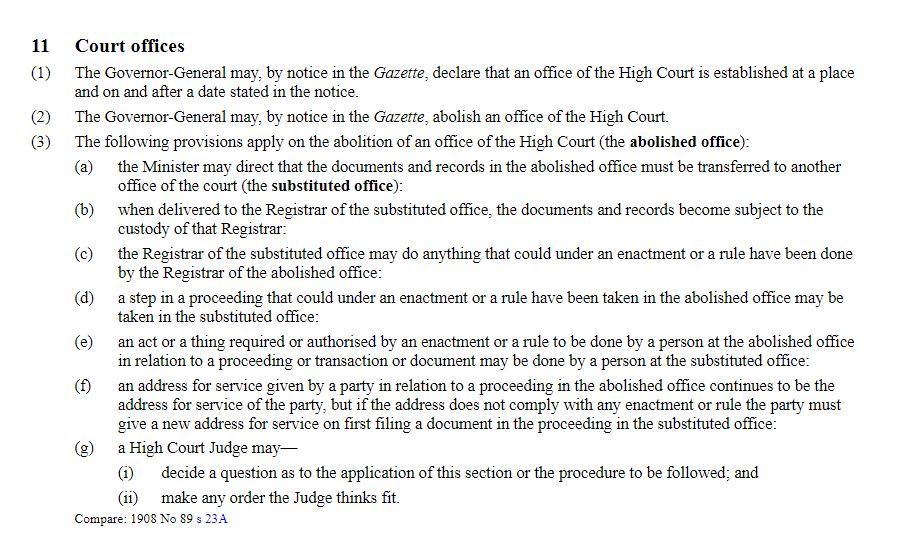
Section 11 of the Senior Courts Act 2016 provides:

Section11.JPG

Give a notice in the Gazette, and you’ve got yourself a High Court, Mosgiel Registry.  Similarly, give a notice saying that the High Court in Wellington is abolished, and there is no longer a High Court in Wellington.  Naturally, it doesn’t change any physical structures.

For the time period that we are interested in, the establishment and abolition of High Court offices was governed by s 23A of the Judicature Act 1908, which is in largely similar terms to s 11 above.

There was a High Court in Wanganui.  The weak point in this argument is that I can’t find the documents establishing it in the first place.  It seems clear there wasn’t one originally.  R v Robinson Coupe from 1861 was a perjury trial in the Wellington Supreme Court that stemmed from false evidence in the Wanganui Magistrates Court.  The implication is that there was no Supreme Court at the time in Wanganui.

But it seems clear there was one.  By 1884 there was a Supreme Court hearing in Wanganui appearing in the New Zealand Law Reports – National Bank v National Mortgage and Agency Company (1885) 3 NZLR 257 (SC):

Wanganui HC
We’re off to Wanganui!

And since then there have been any number of decisions out of the Supreme Court and then the High Court at Wanganui.

Except Wanganui is not Wanganui any more.  It is Whanganui.  And it has been since 19 December 2015 when the Minister of Land Information accepted the recommendation of the New Zealand Geographic Board and gazetted the change.  This replaced an earlier change where the official name was both Wanganui and Whanganui.  The change is only one letter (in English, adding an H, in Māori changing the W to a Wh).  But the quality of the change is akin to a complete renaming.  The difference is one of degree only.  (A further technicality is that there is no city of Whanganui, the town takes its name from the district of Whanganui, which is what was changed in 2015.)

But, and I am slowly getting to the point, the High Court office was never abolished in Wanganui and re-established in Whanganui in 2015 when the name officially changed.  And no one has done it since.  That means the earlier High Court office at Wanganui continues to exist (in a legal sense).  It doesn’t matter that they are the same physical buildings.  If Auckland was renamed Obiterville, we would still have to refer to the High Court at Auckland until an Obiterville office was established.  The difference between Wanganui and Whanganui is small but it exists.

Of course, the registry currently purports to be the Whanganui registry:

Whanganui Registry


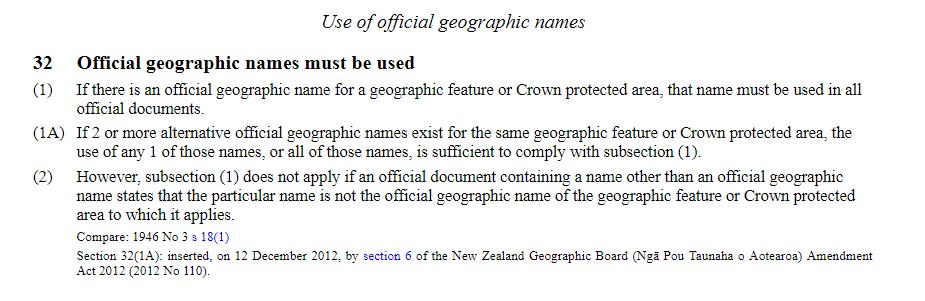
But the judicial branch has to do that because of s 32 of the New Zealand Geographic Board (Ngā Pou Taunaha o Aotearoa) Act 2008 requires all government agencies to use the official name for a place:

Section 32.JPG

And if you track back through the definitions of this Act, which links to the definitions in the Public Records Act 2005, that ends up applying to the judicial branch and court judgments.

So the court is required to refer to the Whanganui registry, even though that has not been established.  The fact that the name appears on judgments is no indication that the office of the Court exists.

The result is that, if you squint, and take many leaps of faith, in a kinda-sort-of way there is no High Court in Whanganui, but there remains a High Court office in Wanganui.  Or at least that’s what I’m claiming.


Fact-checking myself, or, the many reasons why this argument is a bit shit

It doesn’t really account for any possible semantic difference between registries and offices.  The High Court Rules 2016 refer to multiple registries, but do not use the term “office”.  Likewise the Senior Courts Act 2016 refers to offices but not registries.  And while the Ministry of Justice website treats as synonymous registry with office, it is possible that there is only one unified “office” of the High Court nationwide, with multiple registries.

It presupposes that a High Court at Wanganui was established in a legal sense (likely in the 19th century).  Which to be fair I think is likely, but without an exhaustive search through hard copy Gazette records is going to be hard to establish.

The whole “H” in Whanganui thing makes it all seems a bit white supremacist-adjacent when it’s only meant to be legal pedantry.


Downs J on writing style

It has been claimed that I have a certain writing style.  It is said to be distinctive.  The word “curial” apparently features.  Three-word sentences abound.  And, sentences beginning with “and”.  More on this later.  Outcomes are announced by the passive voice.

Doubt attaches to the claim.  I reject it for three inter-related reasons.

First, anyone can write in short sentences.  It is simple.  Only a full stop is required.  And, if the tone invokes a clipped manner, that is to be expected.  Curial process does not admit loquacity.

Second, commencement of sentences with conjunctions is unremarkable.  However, and, and but, especially when followed by commas, are used by many.  And, they add to readability.  And, contribute bounce.  Many must read, and understand, curial decisions.

Third, the claim is cast broadly.  That is not insignificant.  It ignores the longer sentences, often comma-strewn, which serve as a counterpoint to the brevity that may, at times, break up any judge’s decision.  Discernment of a pattern is difficult at best.  Curial workings are not so easily satirised.

Insuperable hurdles plague this claim.  Rejection must follow.

A final observation.  I do not always end with a final observation.

The claim is dismissed.

Supreme Court Guess Who, or who will hear a Lundy Supreme Court appeal?

Guess Who Board2

This week the Court of Appeal released its decision in Lundy v R [2018] NZCA 410 in which it said that expert evidence about mRNA that was admitted at Mr Lundy’s retrial was inadmissible.  That judgment mentioned, but did not dwell on, the fact that a differently constituted Court of Appeal had ruled the evidence admissible in an earlier pre-trial admissibility challenge (Lundy v R [2014] NZCA 576).  Awkward.

Regardless, said the latest incarnation of the Court of Appeal, the inadmissible evidence did not lead to a miscarriage of justice.  There was other evidence available to support a conviction.  It applied what is called “the proviso” and upheld Mr Lundy’s conviction.

Since then, there have been murmurings about an appeal to the Supreme Court.  I divert briefly here to say I’m not sure I immediately see on what grounds the Supreme Court would grant leave.  The two most likely grounds (and even then…) seem either to have another look at the proviso (although that seems reasonably well-settled), or else allow leave on the general miscarriage ground (but they’d probably want to restrict the points on which they allow argument rather than allow a complete rehearsal of all the points taken in the Court of Appeal).

Assuming an appeal is taken, and assuming leave is granted, who would hear the appeal?  The available pool of justices seems slim for the following reasons.

The current permanent Supreme Court bench is as follows:

  • Elias CJ
  • William Young J
  • Glazebrook J
  • O’Regan J
  • Ellen France J

Any appeal will be heard next year, at which point Elias CJ may well be retired (her Honour retires in March 2019), but she will presumably stay on as an acting Judge (and will be first off the rank for acting Judge according to this policy).

The three likely replacements for Elias CJ are:

  • Kós P
  • Winkelmann J
  • Williams J

And then remaining on the potential acting Judge rank are (in order):

  • Arnold J
  • McGrath J (he is listed on the Court website but it may not be updated.  He is not listed as an acting Judge in the front of the New Zealand Law Reports.)

Having set up our Guess Who board, let’s start eliminating contenders.  Remember, we need five to sit on a Supreme Court panel.  I am also assuming that having sat on a previous hearing will be enough for disqualification.  It may be that the Court takes a tougher line on disqualification.

Did your Supreme Court justice sit on the Privy Council board that allowed Mr Lundy’s appeal in [2013] UKPC 28, [2014] 2 NZLR 273?

Eliminate Elias CJ from contention.

Did your Supreme Court justice sit on the most recent Court of Appeal decision dismissing Mr Lundy’s appeal in [2018] NZCA 410?

Eliminate Winkelmann J from contention.

Did your Supreme Court justice determine that the mRNA evidence was admissible at pre-trial first instance on the retrial following the Privy Council decision?

Eliminate Kós P from contention.

Did your Supreme Court justice determine that the mRNA evidence was admissible at pre-trial appeal on the retrial following the Privy Council decision in [2014] NZCA 576?

Eliminate Ellen France J from contention (although she was in the minority that would have allowed the appeal).

Did your Supreme Court justice sit ALL THE WAY BACK IN 2002 on Mr Lundy’s first appeal to the Court of Appeal in (2002) 19 CRNZ 574 (CA)?

Eliminate Glazebrook and McGrath JJ from contention.

Do we have anyone left?

Who does that leave?  The best case scenario for available judges is that Williams J gets promoted to the Supreme Court following Elias CJ’s retirement.  The permanent members who can sit will then be William Young, O’Regan and Williams JJ.  Assuming Arnold J can still be drawn upon (his acting warrant lasts until 11 April 2019 but he might be authorised to sit on the proceeding), that makes four.

So it would seem likely that the Supreme Court would draw on the next most senior Court of Appeal justice (as per their stated policy online – although not expressly required by the Senior Courts Act 2016).  Except they can’t!  Because that is French J, who also sat in the [2014] NZCA 576 Lundy proceeding.  That leaves Miller J.

But worst case would be if Winkelmann J goes to the Supreme Court in place of Elias CJ.  That means that only William Young and O’Regan JJ can sit.  They can draft in Arnold J (again, assuming his warrant gets extended or he is otherwise authorised to sit).  Then Miller J comes in from the Court of Appeal to take it to four members.  But then the next two members of the Court of Appeal are not eligible – Cooper and Asher JJ both sat in the most recent Court of Appeal decision.  So Brown J could end up sitting on the Supreme Court for the hearing of any Lundy appeal.


EDIT (18 September 2019): As always, I’m not quite right about these things.  Miller J did sit.  In the time before the post and the hearing, Winkelmann and Williams JJ both went to the Supreme Court.  Arnold J sat as an acting judge.  The panel was William Young, O’Regan, Williams, Arnold and Miller JJ.  But, I was significantly wrong in another respect because I did not obey the first rule of legal work: “Read the bloody statute”.  Section 110(3) provides that “Only 1 Court of Appeal Judge appointed under subsection (1) may be present at a sitting of the Supreme Court for the hearing of a proceeding”.  So there was never a chance of Brown J sitting.
Supreme Court insists it has already delivered decision in Attorney-General v Taylor

The Supreme Court of New Zealand today issued a press release insisting it has already delivered a decision in Attorney-General v Taylor SC65/2017.

“You must not have received it,” said Chief Justice Dame Sian Elias.  “We’ve been having some problems with our Outlook.”

The Court heard the case, which deals with important constitutional issues of prisoner voting rights and the ability of the courts to grant declarations of inconsistency with the New Zealand Bill of Rights Act 1990, over two days in March 2018.  Since that time the decision has been eagerly awaited by the government, Parliament, academics and lawyers.

“The fact is that the Court has delivered a judgment, and definitely sent it to you all.  It’s weird that you didn’t get it but that’s ultimately not our fault,” Elias CJ continued.

When pressed on the outcome of the case, William Young J stated he “couldn’t remember” and “it’s not that important anyway, I’d just forget about it if I were you.  It might have got lost in the post or something.”

When asked whether a further copy of the judgment could be provided a Supreme Court spokesperson said that the court was having printer difficulties at the moment.