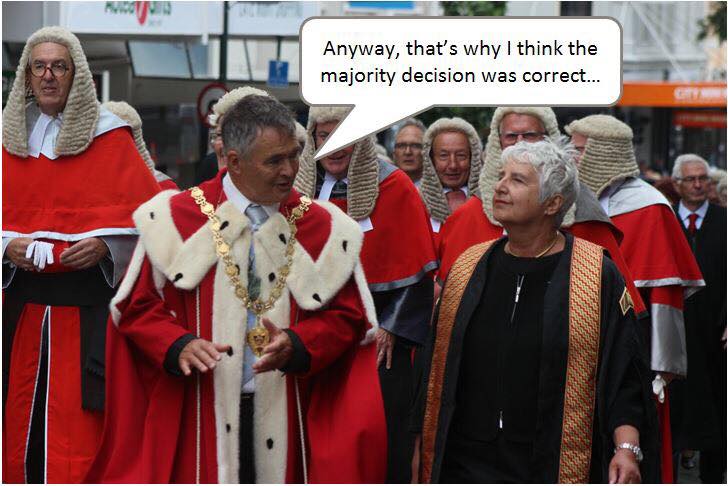
The function of appellate judges (part two)

See also: The function of appellate judges
Inspirational judicial quotes, vol. 1

The best New Zealand law firm URLs
doglaw.co.nz (Not really about dogs, but an acronym for the firm. Should be about dogs.)
jaws.co.nz (Not really about the movie Jaws. Should be about sharks.)
dalaw.co.nz (Da best at da law!)
approachablelawyer.com (Whether you want an approachable lawyer, or just want to approach an able lawyer, this chap is for you.)
phlaw.co.nz (For legal advice that’s phlawed.)
legaleagle.co.nz (Sacrificing name recognition at the altar of rhyme scheme.)
Honourable mention: honestlawyer.co.nz (a pub, not a lawyer. When this domain name becomes free I’m totally stealing this.)
How to be a better lawyer in 2018
Warning: contains earnestness.
Add your two cents like you’re a dissenting Supreme Court judge

Don’t be silent and never be afraid to give your opinion, even if you disagree with others. Imagine you’re a Supreme Court justice and four of your colleagues have already written judgments. The chances you have the “right” answer are slim. Your co-workers are three of the top legal minds in the country (and O’Regan J). Chances are that Glazebrook J has got it right.
Yet, in 2017, the Supreme Court attempted to evoke its “greatest hits” era and issued (at least) two five judgment decision in Proprietors of Wakatu v Attorney-General [2017] NZSC 17, [2017] 1 NZLR 423, and Scott v Williams [2017] NZSC 185. In many respects, many of the judges agreed, but each of them was unafraid to express their differences.
You should do the same. Conformity is overrated. And extracting a consensus from the competing views is not your job (that’s for those losers in the Court of Appeal: see for example Lorigan v R [2012] NZCA 264, (2012) 25 CRNZ 729 at [26]-[38] where the Court picked up the toys thrown from the Supreme Cot). Never be obstructive, but never be silent. Act like a Supreme Court justice and give your probably wrong opinion.
This principle applies even if you are not a Supreme Court judge. The 1983 film The Right Stuff follows the space race during the Cold War. Both the Americans and the Soviets relied heavily on former Nazi rocket scientists. In the film the chief American scientist predicted confidently the triumph of the American space program because “our Germans are better than their Germans”. The quality of all legal decision making operates on a similar principle even if very few clerks are German.
Hold true to your values like the Parliamentary Counsel Office

Don’t let anyone make you change the things that are truly important to you.
One of the lesser known aspects of the separation of powers is the battle that rages, unspoken and eternal, between the legislature and the executive over the use of the Oxford comma. Legislation consistently uses the Oxford comma (see para 3.51 of the Parliamentary Counsel Office’s Drafting Manual). The executive kicks it to the kerb.
Acts of Parliament create and empower a “Plumbers, Gasfitters, and Drainlayers Board”. But the executive calls it the “Plumbers, Gasfitters and Drainlayers Board”. So too the Ministry of Business, Innovation, and Employment and the Registrar of Births, Deaths, and Marriages.
One day this will be my Fitzgerald v Muldoon crossed with Barton v Air New Zealand. In the meantime, it is a good lesson. Be like the Parliamentary Counsel. Always fight the good fight.
Never be a lawyer who doesn’t care

Apathy is bliss. Last year I was sent to make the oral arguments in an application to admit propensity evidence. To say it was a disaster from start to finish risks understating just how disastrous the middle bits were as well. At the end, the judge ruled that what I wanted admitted couldn’t even be described as propensity evidence. That didn’t make the evidence admissible. It just meant that s 8 of the Evidence Act could then take a crowbar to my arguments. The application was a no-hoper. The worst part was that the judge was very polite and apologetic about it.
I think it would have been easier to not care about the result. But instead, I returned to the office embarrassed and ashamed that the application had even been brought, that I had fronted it, that I hadn’t convinced the judge to agree with me, that the lawyer on the other side (whose talents I respected) saw me stumble, and (above all) that I may have jeopardised the substantive case by failing to have evidence admitted.
Until I reflected on it more, that was the low point of my legal 2017. And until I reflected on it more, the high point of my legal 2017 had been pointing out in a hearing that as of the previous month, Parliament had actually enacted new legislation governing the area the court was discussing.
The reflection is important. It has made me realise that my so-called high point is in fact an instance of insufferable know-it-all-ism; my largest vice that moonlights as a virtue. It has also made me realise that my low point felt so low because I cared about all the things that made me feel the embarrassment: the stakes, my reputation, the application of the law in that particular case. And expressed that way it’s something I want to hold on to.
Time to stop before the saccharine overpowers us all. Here’s to more ignominious defeats that I can optimistically dress up as learning experiences.
High Court judges and modern conveniences
Sentencing notes in R v Santa Claus
Sentencing remarks of her Honour Judge E M Tinsel:
[1] Santa Claus, on 13 October 2017 a jury found you guilty of one charge of burglary.[1] You have earlier pleaded guilty to one charge of possession of a class A prohibited substance, namely methamphetamine.[2]
[2] I have listened closely to the submissions of your lawyer and counsel for the Crown and have read all of the written material that has been placed before me. You may remain seated until I come to formally pass sentence.
Facts
[3] The burglary conviction arises from events in the early hours of 25 December 2016. At a residential address in Grey Lynn you entered a private dwellinghouse, gaining access by way of the chimney.
[4] The jury’s verdict means that they must have accepted the Crown’s contention that you entered on to that property with the intention of committing an offence under s 216F of the Crimes Act 1961. I therefore sentence you on the basis that you intended to make an unlawful disclosure of information gathered while undertaking maintenance of a communication system. The occupants had written letters to you using the mail system that you have partial responsibility for maintaining. You entered the property with the intention of disclosing what the occupants wanted for Christmas by delivering presents for each individual occupant knowing that they would be opened in the presence of the others.
[5] You committed the offence with the assistance of nine accomplices, namely reindeer that remained in getaway driver roles on the roof of the house while you entered. They have already been sentenced for their roles and received non-custodial sentences.[3]
[6] Upon entering the lounge of the house you removed several presents from a bag that you carried with you. You placed these under a Christmas tree in the lounge and then began to help yourself to a plate of biscuits that had been left for you.
[7] You were discovered when you triggered an internal burglar alarm that alerted Police who caught you in the act.
[8] When the Police who arrested you searched your pockets they found 1.2 grams of methamphetamine. You admitted that it was for personal use, and claimed that it assisted you to stay awake and keep moving in what you described as a stressful and fast-paced job.
Aggravating features
[9] There are several aggravating factors in your offending.
[10] First, you entered into a private residence while people were sleeping. People are entitled to feel safe in their homes. You removed that sense of safety. While I accept that your entry was not forcible, no person truly expects any person to come down the chimney. Indeed, given your size it is most extraordinary how you managed this.
[11] Second, premeditation. There is evidence that you prepared this offending against the victims. You saw them while they were sleeping. You knew when they were awake. You waited for a time when the victims were most vulnerable; when no creature was stirring, not even a mouse.
[12] Third, the number of offenders. Although your co-offenders played a more minor role, and did not enter the house the sheer number of offenders would have added to the intimidation.
[13] There are no mitigating features of this offending. Neither mistletoe nor wine can lessen what you did.
Purposes and principles of sentencing
[14] In sentencing you today I have had regard to the purposes and principles of sentencing as contained in ss 7-8 of the Sentencing Act 2002. For your offending the most important purposes and principles are to denounce your offending and deter others from burglary. The sentence imposed must be the least restrictive possible, and offer you rehabilitation where possible.
Starting point
[15] There is no tariff case for burglary given that the circumstances in which burglaries arise can vary greatly. In a case called Arahanga v R the Court of Appeal held that for a burglaries of two domestic dwellings the starting point is between 18 months and two and a half years.[4]
[16] Today both counsel have referred me to a range of sentencing authorities that they claim are comparable. I take those into account, but the unique factors of this case means that it really falls to be determined on first principles.
[17] For the aggravating factors identified above I set a starting point on the burglary at two years and three months’ imprisonment.
[18] I uplift this by a further three months for the possession of methamphetamine. No reduction for totality is warranted.
Personal aggravating and mitigating features
[19] Turning to factors personal to you, the PAC Report makes for dim reading. The report writer notes your lack of criminal history, but explains the sense of entitlement. You told the report writer that you divide the people you meet into two groups: “naughty” and “nice” in an attempt to justify your behaviour to them.
[20] You also indicated a callous disregard for your victims saying that they should have expected this when you came to town. The report writer records you as saying that they should not shout, cry or pout.
[21] I therefore decline to give a discount for remorse.
[22] You have an unblemished record. I am in two minds about giving you a discount for this. A discount for previous good character is often justified on the basis that a conviction and the associated fall from grace represents a significant punishment for a first time offender, as well as the prospects for rehabilitation.[5]
[23] Your counsel has emphasised the immense personal consequences this conviction will have for you. You have been stripped of your sainthood by the Greek Orthodox church.[6] The conviction will mean that the Civil Aviation Authority will likely no longer consider you a fit and proper person to hold an aviation licence and as a result this will mean you can no longer pilot a sleigh within New Zealand airspace.
[24] However, while you have no convictions, this trial was remarkable for the Crown leading no fewer than 563 million instances of propensity evidence in which you have acted similarly. None of those have led to convictions, and I consider that I must sentence you on the basis that you do not have a criminal record. Nevertheless, the discount will be small. I give a two month discount for your lack of previous convictions and the personal consequences.
[25] Although you pleaded guilty to the possession charge, you opted to defend the burglary at trial. I will discount a further one month for the guilty plea on the possession charge.
[26] That leaves an end sentence of two years’ imprisonment.
Home detention
[27] A sentence of two years’ imprisonment is a short term of imprisonment that is convertible to home detention.
[28] The address you provided at the North Pole has been assessed as unsuitable for home detention as your co-offenders all live there as well.
[29] However, even if the address had been suitable I would have declined to convert the sentence to one of home detention. Only a sentence of imprisonment is adequate to respond to your callous offending.
Outcome
[30] Mr Claus, please stand. On the charge of burglary I sentence you to two years’ imprisonment. On the charge of possession of methamphetamine I sentence you to three months’ imprisonment to be served concurrently.
[1] Crimes Act 1961, s 231(1)(a). Maximum sentence 10 years’ imprisonment.
[2] Misuse of Drugs Act 1975, s 7. Maximum sentence 6 months’ imprisonment, $1,000 fine.
[3] R v Dasher, Dancer, Prancer, Vixen, Comet, Cupid, Donner, Blitzen and Rudolph [2017] NZDC 34564.
[4] [2012] NZCA 480, [2013] 1 NZLR 189, (2012) 26 CRNZ 63.
[5] See the recent discussion of the Court of Appeal in Taylor v R [2017] NZCA 574 at [24]-[25].
[6] I note you held this under the name Saint Nicholas. Today, counsel for the Crown has submitted the use of aliases means I should place a lesser weight on issues of good character. Nevertheless I will give you the benefit of the doubt.
Judicial language decoded
“The exigencies of a busy list court” – the cause of any and all shortcomings in the decision under appeal.
“This case falls to be considered on first principles” – the state of the case law is a mess and my clerk is away.
“A further discount in sentence for rehabilitative prospects is warranted” – I am fudging this to get to the end point I want.
“The experienced District Court judge” – the judge with whose decision I agree.
“With respect” – with no respect.
“The circumstances of this case are clearly distinguishable” – they’re not, but I disagree with the Court of Appeal.
“I remind myself that…” – you can appeal, just not on this point.
The function of appellate judges
[A]ppellate judges watch from on high the legal battle fought below, and when the dust and smoke of battle clears they come down out of the hills and shoot the wounded.
- Black v State 723 SW 2d 674 (Tex Crim App) at 677.
Legal Halloween part 2

 Strictly obiter