One of the greats

Friends of Vicki McCall are fundraising to endow a prize in her name. Many of you will have known Vicki. Those that don’t could read more about her here. She was a colleague and mentor. I still think about her all the time.

You would have liked Vicki. Whatever public law in New Zealand is now, or what it will be in the future, it is and will be less for not having Vicki a part of it.

You can read more about the intended prize and support the Givealittle here: https://givealittle.co.nz/cause/vicki-mccall-memorial-prize-in-public-law

I’ve never asked for anything for the nonsense collected here. If anything, I’ve always felt readers would have grounds for compensation. But if you’ve ever felt at least mildly positively inclined to anything I’ve written, then supporting the scholarship would mean a lot. (This request doesn’t apply to the KC that got grumpy at me for my Mark Lundy tweets.)

Dear Andrew, this is the Court of Appeal

Dear Andrew,

This is the Court of Appeal. We are writing to you in light of your touching and warm-hearted judgment recording the resolution of an appeal about care arrangements, in the form of a letter to young Claude. 

Please don’t.

Judgments need to be understood by their readers. In a case about care arrangements there is probably no more important reader than the child or young person involved. But it also the case that judgments demand precision of language and, by their nature, resolve and record complicated concepts. It is the formal resolution that the parties need, and the system requires. Departure from that mode risks imprecision and imprecision risks error and appeal, to the detriment of the system, the parties, and the child or young person involved.

Or, put another way, the senior courts issue summaries of judgments to assist in public understanding. So why can’t the summary just be the judgment itself? Because the formal site of the exercise of public power brings with it complexity and formality, no matter how much we might wish it to be otherwise. 

We know that context matters, and that your letter recorded an agreed position reached in court, rather than formally adjudicating an active dispute. We have no doubt that you picked your moment and that had the matter been bitterly contested you would not have jeopardised Claude’s interests by failing to issue a judgment in more formal terms. But the thing is, allowing letters as judgments is going to encourage some other judge somewhere to release a judgment in the form of a poem. We know our colleagues. Some of them are just itching to do that. We already have to put up with occasional secret messages in judgments, or the comedy stylings of Hammond J. Then it will be blank verse. After that, it’s not going to be long before this Court is having to issue judgments explaining why the Family Court at Masterton was wrong to determine shared day-to-day care arrangements by means of a mime performance scored to the Netherworld Dancing Toys.

So, while the LinkedIn set have enjoyed the letter and hold it up (correctly) as an example of a good judge doing a good thing, they will also realise that it is tomato sauce. Tomato sauce is nice when it accompanies a proper meal. But no one wants a plate of tomato sauce.

If you really have to, put it an appendix next time.

Lastly, we don’t watch much league here in the Court of Appeal, but if you had any thoughts on La Dorada’s run at Karaka then we’d be happy to receive your ranking out of ten. 

Warm regards,

The Court of Appeal

Supreme Court asks Attorney-General to amend s 7 Bill of Rights Act report

The Supreme Court of New Zealand has taken the rare step of asking the Attorney-General to amend her s 7 report into the Electoral Matters Legislation Amendment Bill.

Under s 7 of the New Zealand Bill of Rights Act 1990, the Attorney-General has the responsibility to “bring to the attention of the House of Representatives any provision in the Bill that appears to be inconsistent with any of the rights and freedoms contained in this Bill of Rights”. The Attorney-General of the day performs this function independently of political affiliation. In the case of the most recent report, Attorney-General Judith Collins KC identified that aspects of the proposed electoral amendments limited the rights of New Zealanders under s 12 (the right to vote), s 14 (the right to freedom of expression), and s 25(g) (the right to benefit of the lesser penalty). The limitations on those rights could not be demonstrably justified in a free and democratic society, and therefore the Bill appeared inconsistent with rights and freedoms guaranteed to all New Zealanders. The impugned provisions included a large-scale ban on prisoners’ ability to vote and imposing a new registration deadline requiring voters to register no later than 13 days before polling day. 

In a letter from the Office of the Chief Justice to the Attorney-General, the Chief Justice of New Zealand Dame Helen Winkelmann asked the Attorney-General to “reflect whether passages of your report risk amounting to spoilers of how the Supreme Court will rule on this in three years time” and to “consider whether the report might be reissued with spoiler tags”. 

While noting that the legislation had not yet been passed, nor first-instance proceedings for a declaration of inconsistency issued, the letter made the point that these matters were highly likely to end up before the Court in due course. It continued that “[a]ny acknowledgment by the senior law officer of the Crown at this early stage that the laws infringe rights and cannot be demonstrably justified are highly likely to be cited in any Supreme Court judgment. For that reason the report might be said to unfairly give away the result to anyone wishing to keep as a surprise what we are going to say in, say, Q4 2027 or Q1 2028”.

In comment to the media, the Attorney-General said she would not be reissuing the report with spoiler tags and that “I do not accept the Supreme Court can be concerned about spoilers when the courts of New Zealand have already held that blanket prisoner voting bans are inconsistent with the Bill of Rights Act. The fact that this government’s intended law breaches rights is a matter of long-standing public record”. 

A spokesperson for Crown Law said that Crown lawyers were presently booking leave for Q4 2027/Q1 2028.

Wellington transport infrastructure litigation: 2026-2028

2026

Sub-contractors in court following cost overruns in seismic strengthening of wharf piles required to protect against ongoing Interislander rammings.

Golden Mile development setback after NZTA’s permission to cull pedestrians ruled unlawful by High Court. 

LIVE WELLington sues to extend character protections to traffic jams around the Basin Reserve.

2027

Four-laning of Chews Lane enjoined by High Court. Successful challenge by Guardians of the Golden Mile who want six-laning.

Legality of Kate Sheppard and Carmen Rupe “green men” challenged by Concerned Ratepayers for Pedestrian Safety and Ulterior Motives.

Challenge to non-notified consent to turn Cobham Drive into a single two-kilometre long pedestrian crossing. 

Speaker’s decision to ban cars from the steps of Parliament challenged by local business associations who say their customers need the ability to park centrally.

2028

Challenge to Commerce Commission grant of permission for airport runway extension. Ten week hearing in the High Court. The most junior counsel to appear is Justin Smith KC. Combined daily legal fees exceed $500,000.  McHerron J spends six months of his life writing the decision. Three paragraphs of a 400-page judgment will come to be regularly cited for the meaning of an obscure subsection of the Commerce Act 1986. The rest will be forgotten when the case goes on appeal.

Challenge to bylaw prohibiting tooting in the Mt Victoria tunnel brought by applicants whose custom car horns blare short excerpts of Mein Kampf. Funded by the Free Speech Union. 

Cable car sued for some reason, probably.

Strictly Obiter Law Awards 2024

It’s been a year of threats to the legal and constitutional order: a Minister calling a judge a Communist! A Minister calling a judge a Communist again when explaining what they meant the first time! A Ministerial apology where we all waited to see if they’d call a judge a Communist a third time!

The plot was lost somewhere around February when Smith v Fonterra set off tizzies so strong that, as of December, some victims have not yet re-hinged themselves. There is, as yet, no sign of the plot returning but we’re left with having to explain to ten per cent of the profession that they are not having an ordinary reaction to an orthodox civil procedure judgment.

Screenshot 2024-12-13 at 4.28.52 PM
Actually, the separation of powers means it’s the Supreme Court that traditionally takes a chainsaw to legislation.

It hasn’t all been fun, though. Sentencing policy is on its way back to the dark ages (the 2010s). There have been more Gary Judd opinion pieces than days to submit on half the Bills before select committees. And a Treaty Principles Bill shows that our commitment to a foundational constitutional document is alive and well as long as that document is the National-ACT coalition agreement. (Please indicate your disapproval of this joke in the traditional way – by voting for it at first reading.)

Personally, I blame the Supreme Court 20 Year Anniversary Conference for setting the tone for the year. It’s a strange birthday party where you invite people to say slightly mean things about you, but there you are. What started as a quasi-academic conference boiled over into about two media rounds of saying the Supreme Court was doing values, not law. It didn’t seem to occur to any of the interlocutors that if the judges really were substituting their own values for the rule of law then we’d have a legal system based on Werther’s Originals. But that didn’t stop every NZ Herald editorial sounding like it was ghostwritten by Muriel Newman. And when good old LawNews started insisting to its readers that freedom of speech meant it had to keep publishing the worst takes known to man, it became apparent to everyone that things were going to get worse before they got better.

Unfortunately, the institutionalists have played a shocker this year. There was no organised response to any of the March madness. The best we got was a statement a couple of weeks afterwards from the Law Society president that amounted to asking everybody to remember to use a coaster, while barstools were being hurled across the room. Plus some dude online, I guess.

Arrest
The decision in Smith v Fonterra was controversial from the outset.

The thing is, you don’t always get to choose when someone puts a coin in the Whack-a-Mole machine. But, when someone is silly enough to do that, you’re going to get moles whether you want ‘em or not. Your only choice at that point is whether you take up the squeaky rubber mallet. And if you don’t, there are an awful lot of moles.

So this year we got:

  • A New Zealand Initiative Report wanting to re-enact s 4 of the Bill of Rights Act but in capital letters and start judicial purity tests.
  • Veiled threats to the Waitangi Tribunal.
  • Proposals to cap sentencing reductions for personal mitigating factors.
  • A return of three strikes.
  • The Treaty Principles Bill. (Everyone knows the Treaty Principles were invented by those activist, anti-establishment ne’er-do-wells with names like Sir Gordon Bisson and Edward Jonathan Somers QC. For 36 years the Court of Appeal’s Treaty principles have worked to the Crown’s advantage as a conservative stopgap against the inevitability of Te Reo text. Why Ministers of the Crown would want to blow up one of the best legal window-dressing tools the Crown has is lost on me.)
  • The Regulatory Standards Bill.
  • Fits of the vapours at updated Prosecution Guidelines. (And, can I just say, the best way to politicise the Guidelines is to withdraw them the first time some cranks don’t like them. I mean, come on, team! Moles everywhere!)

And while the fightback on the New Zealand Initiative report was pretty good, I’m sorry to report it’s still at least 5-1 to the baddies this year, and the one point was only thanks to overburdened stalwarts like Te Hunga Rōia Māori o Aotearoa fighting the good fight like they always do.

This is all immensely depressing for people like me who would prefer to be making fun of the Supreme Court for being weird and out of touch and not doing anything with public law. Instead, I find myself having to defend the same judges that took 876 days to issue judgment in Royal Forest and Bird. I pray that 2025 is a year that other people are out there boosting our courts and judges so that the 2025 Law Awards can be me saying mean things about the Supreme Court like normal.

Anyway, here are the awards.


Understatement of the year

Watts

Suppression order of the year

The Justices of the Peace that suppressed their own names when hearing Kerry Prendergast’s parking ticket case. You’ve heard of the The Secret Barrister but have you heard of the Secret JPs?

Far from being some threat to open justice, this is the justice system working as intended. Every legal system needs 20-30 judicial JPs, 8-10 District Court judges, and 1.5 High Court judges just making the most bananas calls you’ve ever seen.

Bad statistics of the year

Winner: NZ Lawyer Magazine

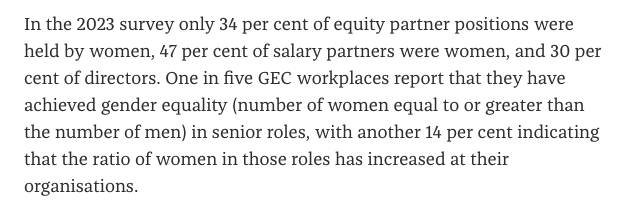
The NZLS Gender Equality Charter Survey found only 34% of equity partners were women.

Equity NZLS

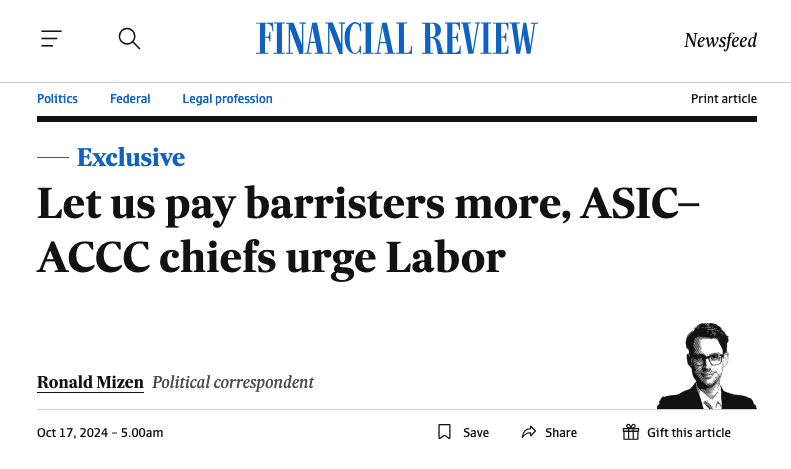
But NZ Lawyer inverted that and reported that 34% of women lawyers were equity partners.

EquityNZLawyer

Progress *is* possible when we do bad stats. Congratulations to 34% of women lawyers!

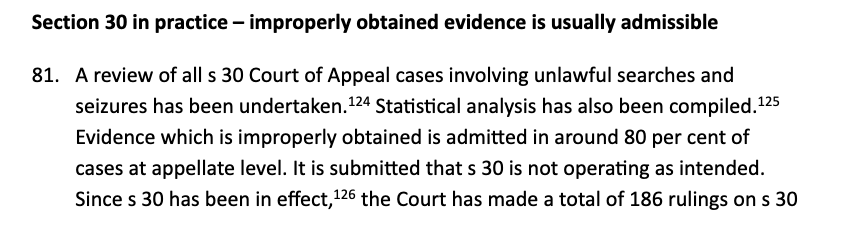
Runner up: the appellant in Tamiefuna v R (SC51/2023).

Screenshot 2024-12-13 at 4.43.41 PM

You can’t reason backwards from the amount of evidence admitted to say the section is too generous! That overlooks the evidence the Crown does not apply to admit because it assesses it will not meet the s 30 test. The only evidence the Court ever assesses is the evidence that the Crown thinks stands a fair chance of passing the test. The fact that 80% is then admitted just bears out the Crown’s assessment. It doesn’t mean the test is too permissive! Or, at least, it’s not a safe basis to conclude what the appellant asks the Court to conclude!

Unwelcome symbolism of the year

Hard To Find Books in Dunedin. Law: a half shelf. Anarchy: a full shelf.

Anarchy

Best case involving a dog

“A dog, like a person, is entitled to credit for a lifetime of good behaviour.”

So wrote Boldt J in Shramka v South Taranaki District Council [2024] NZHC 3064. Dexter the black labrador/ridgeback cross might have got a sense of which way the appeal against his destruction was going when his Honour managed to record he was a “beloved family dog”, “relatively elderly”  and with “no record of his attacking anyone before” by paragraph 4 of the judgment. As a result of upcoming sentencing reforms, Dexter will soon be allowed greater reductions for personal mitigating factors than his owner.

Second best case involving a dog

The Human Rights Review Tribunal declining to award disbursements for the cost of kennel accommodation for a party’s dogs in Cunliffe v Helensville Primary School Board of Trustees [2024] NZHRRT 28.

Screenshot 2024-12-16 at 10.04.40 AM

So it’s yes to black lab/ridgeback crosses and no to boarder collies.

Sir Richard Wild Medal for Commitment to the Rule of Law

The rule of law requires that the law be knowable in advance. Concerned that young people might miss out on vital information about populist sentencing reform, Minister of Justice Paul Goldsmith reached out to the natural home of ram-raiding youths – LinkedIn – to give them an important update.

Goldsmith1

Headline of the year

Screenshot 2024-12-16 at 5.19.52 PM
Amen!

Flimsy defence of the year

When challenged about Shane Jones calling Gwyn J a communist judge:

Defence

I mean, okay. But if I call a judge childish, I can’t justify that by saying that it is a matter of public record that the judge was once a child.

Communist judge of the year

It has been explained to me that I’m not allowed to do this one.

Acronym of the year

An organisation for our times: Calm Alarming Law Madness!

CALM

Ground of appeal of the year

Now, I’m no one’s idea of an employment lawyer, but when the Court of Appeal grants leave in these terms that seems bad to me.

Leave

Social media power user of the year

You are the Attorney-General Judith Collins.

It is 21 March. At 4.00pm, you are called to the Inner Bar.
Collins1

The ceremony finishes. There are some pleasantries. People shake your hand. Your dinner reservation is for 6.30pm. Just enough time to hop on Twitter and start arguing with people about whether and how New Zealand criminalises hate crime.

Collins2

You are still wearing your ceremonial wig.

Most concerning footnote formatting of the year

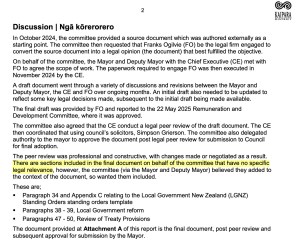
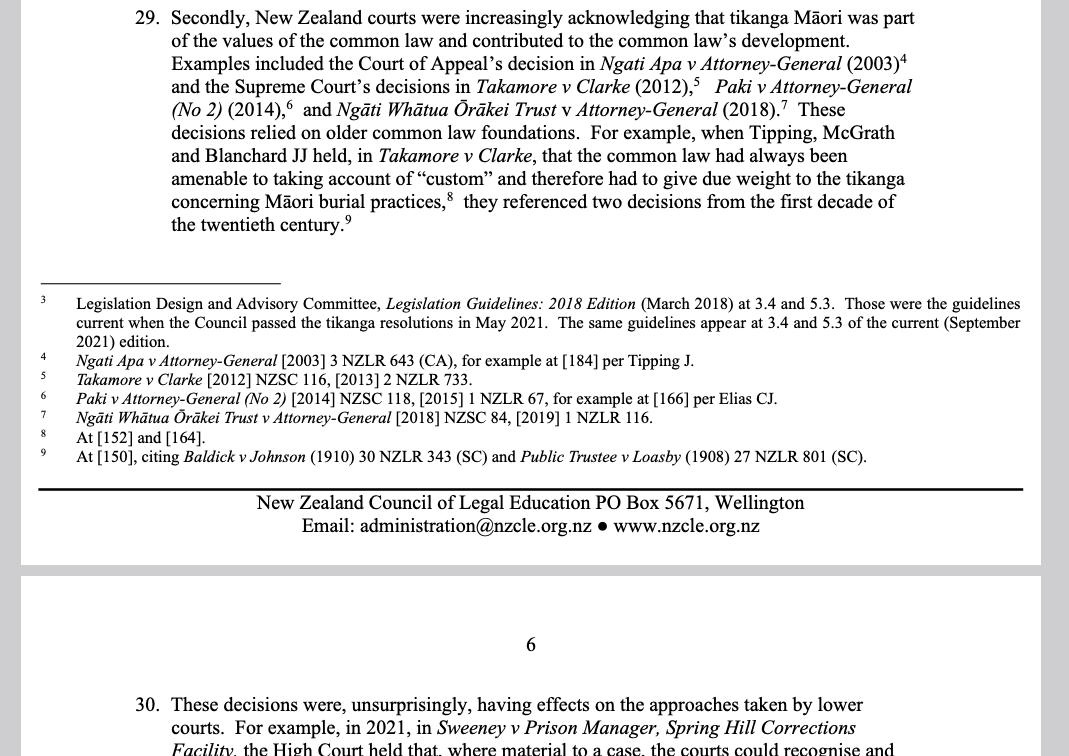
The New Zealand Council of Legal Education’s submission to the Regulations Review Committee about the inclusion of tikanga in the law school curriculum. A crisp, calm explanation of the Council’s role, that was fronted by a crisp, calm Campbell J. At times, one of the best pieces of legal writing I’ve read this year (it really kicks into gear from para 34 onwards).

But its footnotes. Check out the margins on this bad boy. Christ!

Screenshot 2024-12-16 at 6.46.29 PM

Best Metaphor for the Common Law

Common law

Ambitious argument of the year

The Crown in Choi v Attorney-General [2024] NZHC 3678 which ventured that an Act called the Victims’ Rights Act did not confer rights on a victim, a submission that Radich J called “a difficult one”.

Choi

Congratulations to all the winners.

I leave you with two things.

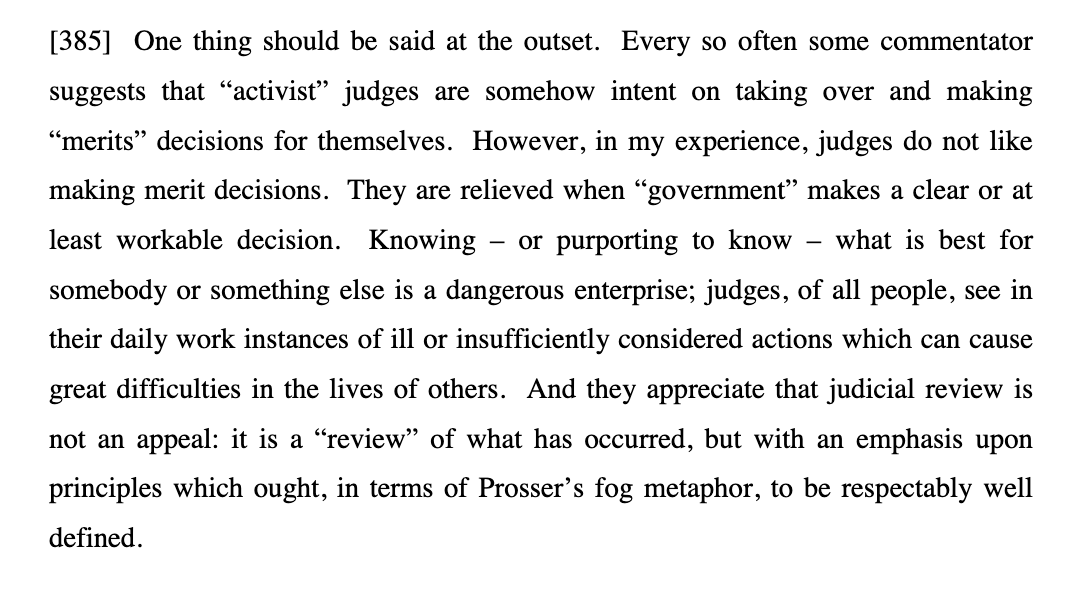
First, a quote from Sir Grant Hammond. It’s evergreen but you might think it particularly timely. Keep it in a drawer somewhere and when things seem particularly fraught in 2025, refer to it as necessary.

Hammond
Hammond J in Lab Tests Auckland Ltd v Auckland District Health Board [2008] NZCA 385; [2009] 1 NZLR 776

Second, I went to the bar this year. My background is in being a lawyer for institutional clients of various kinds which is mostly what my practice at the bar still is. But in the last two weeks one of my first private clients came to me with a problem that was really important to them and asked for my help. So I helped them by using the skills that other lawyers have taught me over the last ten years or so, and other lawyers played their part too, and there was a really good result, which I know there often isn’t. But I helped make it happen and… it felt really good?! (This is not a brag – the other private case I did this year, Venning J called my argument misconceived and the Crown Counsel literally ran out of words in the hearing to explain how I was wrong.)

I’m still turning the experience over in my head – the power that lawyers have to help people. I think it feels strange because too many years of public law acting for the Crown and regulators has left me thinking of power in the law as associated with actual legally-conferred power like a judge with the power to make decisions or a Minister conferred statutory powers of decision. And without wanting to have you all shout at me for not discovering the obvious until I’m 34 years old, the responsibility to use the power that lawyers have to help more clients is something that has me excited about 2025. But first a rest. Stay well.

Activist Supreme Court subverts rule of law

It’s what we were warned about, but we didn’t listen. Our Supreme Court judges whipping out the stiletto of judicial supremacy from below their robes and lunging at the rule of law. The statute books used as mere kindling for fireplaces in judicial chambers while the flag of juristocracy flies from 85 Lambton Quay. When the post-mortem certificate of Lady Justice is signed, the decision of A, B and C v D and E Limited [2024] NZSC 161 will be listed under cause of death.

The case purported to be about whether fiduciary relationships exist between parents and children and whether they persist into adulthood. In its judgment, the Court subversively confirmed the indicia for fiduciary relationships are those found in the leading Supreme Court decision of Chirnside v Fay – a decision written by Communist judges Blanchard and Tipping JJ. And Paper Reclaim? Amaltal v Maruha? Bristol and West Building Society v Mothew? The way that this decision fits so well with all of these cases is all the confirmation that you need that judicial subversion of democracy has been a decades-long project.  

A veiled judicial power-grab then ensued as the Court rejected the leading Canadian approach as offering too little guidance and preferring the long-standing New Zealand approach “as providing greater clarity as to the circumstances in which a fiduciary relationship will be found to exist” (at [50]). While on its face this might seem to bring greater certainty to the law (and reduce judicial discretion at the same time), you would have to be pretty credulous to accept that at face value. Then, in what I can only assume is some sort of double bluff, the Court declined to adopt more recent Kós J equitable murmurings in Dold v Murphy that sought to supplement Chirnside v Fay. It instead reaffirmed the general approach in Chirnside v Fay.

Having brazenly committed itself to an application of long-standing principle, the Court then considered how it should apply to parent-child relationships. As the Court observed, “[t]he law in relation to the coincidence of fiduciary and family relationships is not settled in New Zealand” (at [55]). Naturally that meant the judges could just do whatever they wanted. Taking full advantage, and under the pretence of a careful tour of domestic and Canadian authority, the Court drew out themes from cases about fiduciary relationships in caregiving relationships with a view to identifying principle. Keeping its insidious motives for these techniques hidden, the Court confirmed that the Chirnside approach meant that “a fiduciary relationship exists between a parent and a minor child while that child is in the parent’s care” (at [63]). This outcome was suspiciously aligned with the tenor of the authorities that it had reviewed and with both parties’ positions.

But if the parent-minor child relationship was to be considered fiduciary, what are the extent of the parent’s duties? Here, the Court shamelessly invented two important reasons why the duties should not be broad. The first of those was because Parliament has legislated to regulate the parent-child relationship “where appropriate and in limited circumstances” (at [65]). In what I am choosing to treat as veiled sarcasm, the Court recognised “there are broad and complex issues of social policy to be weighed in determining just where such regulation is appropriate” that it pretended made judicial intervention inappropriate (at [65]). Second, the Court recognised that it was “important that the law not intrude unnecessarily upon a relationship which is primarily based upon natural love and affection, and which is so multifaceted” (at [65]). Alas, by sticking its oar in in this way it simply confirms the Court’s typical insistence that judges be able to have the final say in all aspects of society.

Then, the Court further confirmed an approach of one of the Court of Appeal judgments, giving clarity through express endorsement and resolving a difference in approach. The Court then proceeded to apply the law to the facts in a straightforward way that resolved the case.

That wasn’t enough for the Court though. It went on to reject other submissions from counsel assisting because the claims were not grounded in the pleadings. This resort to standard concepts of civil procedure had chilling parallels with Smith v Fonterra where it had declined to strike out a claim on the basis it disclosed reasonably arguable causes of action.

And then when invited to apply tikanga as relevant to the recognition of fiduciary duties, the Court said (at [83]):

We do not deny the great wrong which was done to the appellants by their father. We accept that tikanga provides another framework for explaining and understanding the harm done to the appellants. But this is not a case where the law had no ability to respond to the justice of the appellants’ claims — there were claims available to them which were not pursued at the time, albeit for understandable reasons. The developments the appellants seek in the law would require a reworking of the fundamental concepts of fiduciary relationships which is disconnected from their doctrinal underpinnings and would be incautious, creating great uncertainty in the law.

All of this is a disconcerting departure from the common law method, the rule of law, democracy, certainty, predictability, consistency, respect for Parliament, and not mowing your lawns after 7pm. Fortunately, the answers are clear. Judicial purity tests will rid us of these turbulent priests of the law, and good luck with judicial activism when we amend the Bill of Rights Act so that section 4 is written in capital letters.

But, in the meantime, the next time you hear about claims of judicial activism, I want you to remember this case.

The New Zealand Initiative jokebook

The New Zealand Initiative will be familiar to readers as an organisation that accidentally let its Law Reports subscription lapse in 1915 and has been attempting to style it out ever since. In an exclusive, we are proud to publish an extract from the New Zealand Initiative’s latest publication – a jokebook full of classic gags and side-splitters bound to delight KCs from ages 75 to 95.

With a foreword by Professor Richard Ekins KC.

***

Why did the chicken cross the road?

Values, probably.

***

How many people does it take to change a lightbulb?

None, changes are for Parliament.

***

“Doctor, doctor! I keep seeing activist judges everywhere!”

“Don’t you think you’re overreacting?”

“Oh my God, you’re one of them!”

***

Your mother is so fat that she makes the thick conception of the rule of law look thin.

***

Knock knock.

Who’s there?

Parliament.

Parliament who?

Don’t start with this again, your Honour!

***

What’s black and white and red all over?

The Bill of Rights Act with my tracked changes on it.

***

That’s what she said. Glazebrook J. In this speech one time.


Did someone call for a defibrillator?

The advent of a lawyer membership scheme for the Free Speech Union is a timely occasion for a quick think about the empirical basis for the claim of an erosion of freedom of speech in the profession.

It’s true the Law Society supported increasing the groups of people protected by discrimination and hate speech laws, which I read as support to ensure consistency within a legal scheme that presently offers selective protection to some groups but not others. I do not read its submission as supporting a lowered threshold. To the contrary, near the start of the submission the Law Society said this:

2.2 The right to freedom of speech is an important right, protected by the New Zealand Bill of Rights Act 1990 (BORA). The Law Society stresses the need for vigilance in safeguarding this right and that any limitation on it must be demonstrably justified as reasonable in a free and democratic society.

2.4 There is a need to be very cautious about deploying the criminal law in this context, and it requires evidence of harm of sufficient magnitude to justify doing so. This means policy- makers need to consider, in relation to each of the grounds of discrimination in the Human Rights Act 1993, whether there is a basis for carrying that ground across to the hate speech provisions in section 61 (and the new Crimes Act provision to replace section 131).

Then there is the Hardie case, a decision about natural justice that keeps being mistaken for a case about freedom of speech. Upon receiving an anonymous complaint about emails that two lawyers sent between themselves, the Standards Committee determined to take no further action because doing so would be “disproportionate to the public interest in pursuing the investigation further” (at [32]). The lawyers’ (justified and upheld) right to be aggrieved at an adverse comment to which they had not had a chance to respond seems to have overshadowed the fact the Standards Committee’s response to the complaint was to end the complaint process before it even had to consider a substantive determination, on the grounds the complaint did not justify troubling the parties further.

These things are against a background of the Lawyers and Conveyancers Disciplinary Tribunal reminding the profession and the public that “[t]he remedy for ill-conceived speech is more speech, not enforced silence”, and that “freedom of expression must be jealously guarded and that lawyers, within limits, must not be fearful of saying unpopular things. If that were to occur, they might be dampened or restricted in their role in advancing the democratic rights of their clients” (Nelson Standards Committee v Grey [2023] NZLCDT 33 at [1] and [54]).

They are also reinforced by the cavalcade of opinion pieces about values, judicial activism and our Supreme Court earlier this year. Hesitancy on the part of lawyers to share unpopular views was not a vice on display. So numerous were the editorials that, even now, neither fish nor chip in this country wants for wrapping.

Vigilance for freedom of speech is a good thing. The profession should not be complacent. And any new group of lawyers is to be welcomed.

The trick is not bursting in to a room full of pilates instructors wielding a defibrillator.

Barrister life

Saturday 1 June

It is a Saturday but since my tenancy in chambers starts from today there is nothing that could stop me going in just to be able to sit in my own office. This does seem very try-hard so if anyone else from chambers is there and questions it I will play it cool and say I am moving things in.

There is no one else there.

I do take things with me. I have an old computer monitor. But I need a laptop stand so I can use my laptop as a second screen. There is a PB Tech a block away, so I walk to buy a laptop stand. I set it up. But then I need an extra dongle to plug in the wireless keyboard receiver. So I walk back to PB Tech. Later, when I need a multibox, I tell myself that I have had enough trips to PB Tech for one day.

When I leave for the day, the front door lock doesn’t work. Everyone here is very big on security. I stand jiggling the lock for over a minute. I dread having to call one of the silks to explain, even though I have my “just moving things in” explanation. It locks when you snib the lock from the inside. It just doesn’t lock when I try to turn my key from the outside. Maybe I wore it out from all the trips to PB Tech. I won’t mention that if I have to phone a silk. Then the lock works. I walk extra fast to the car to burn off the adrenaline.

Sunday 2 June

It is still the weekend but I go in again. I have work to do – some discovery for my much-more-talented wife. I avoided discovery during my early career, so I am not a LawFlow native. Who do you set as author and recipient of a long email trail with multiple authors? Just the people in the top email, or everyone in the trail? I feel if the Court of Appeal had said something about this I would know the answer.

It feels nice to work in my own office. Nice and also cold because I don’t know how to work the after-hours heating.

Monday 3 June

Monday, so everyone else is here. They are very kind. I am shown how to print documents, which is very important. It is a warm welcome. Warm figuratively, because it turns out I don’t know how to work the in-hours heating either and I am too nervous to ask. I will see if I can bring it up naturally in conversation later.

Tuesday 4 June

My wrists are very cold because it is tough to work things into conversation when everyone is in their own office. It is easier to speak to people in open plan because you can see when they are doing NYT Connections and know you can interrupt them. On the plus side, no one can see me doing NYT Connections in my office. I am still doing discovery. I am drinking hot Milo from a hand decorated mug I found in the pantry. On one side it says Simon. On the other side is a stamped logo of Russell McVeagh McKenzie Bartleet & Co. There is no one here called Simon any more. Maybe Judge Lance left it behind. In between sips I warm up my wrists on the side of the mug.

I’ve got the front door lock down to about 30 seconds now.

Wednesday 5 June

I have come in early to spray CRC on the bathroom door hinges because they are very squeaky. I don’t think people will mind but just in case I am doing it when no one is here.

Months ago my much-more talented wife suggested we both sign up for the NZBA Appellate Advocacy Masterclass. I figure the name Mooting for Grown-Ups was taken.  Enrolling seemed like a very good idea at the time but since then I have received the materials. It is based on Burke v R – a case about s 66(2) party liability, which I have never understood. The course is on Friday and I have to make 20 minutes of submissions in front of a room full of people. It is now Wednesday. Previous efforts at reading the materials have produced what, with considerable further study, might one day verge on a basic understanding. The course is co-convened by one of the silks from chambers, so the imperative to not suck is overwhelming. The instructions say don’t read the Supreme Court decision in Burke. This is easy to comply with because when it came out a few weeks ago I breezily dismissed it as relating to s 66(2) and didn’t pay any attention to it. If I don’t understand it by Thursday night I will break the emergency glass and read the SC decision.

Thursday 6 June

I wear a large cardigan in my office because the heating it still a mystery. As well as wrist-warmth, the cardigan is a source of stress because I have worn jeans every day and already suspect I am slightly underdressed for chambers. The addition of the cardigan – which is very cozy but comically large – is probably taking the piss. I keep my door shut so people don’t see me wearing it.

For most of the day the concepts and cases in Burke swirl around just out of reach. I figure I just have to keep reading the impenetrable fine print enough times until I get a handle on the big picture. Once I know the big picture the details will make sense. By the end of the day the ideas are just starting to cohere and I write out thoughts for maybe 20 minutes of submissions, and post-it-note pinpoint references in three of the more understandable cases in the bundle of authorities. This might work as long as I get no questions about arguments for party liability for s 168 murder, which I do not understand. I include a West Wing “10 word answer” in the introduction. It is probably too gimmicky – too pat, and it will sound rehearsed even though I don’t really have time to rehearse it. If I hate it in the morning I will delete it. The silk stops by to ask me how I am going with my preparation. Going okay, I say. I won’t read Burke and will roll the dice.

When I leave that night the lock gives me grief again.

Friday 7 June

D-Day. The Masterclass thing is offsite. Terence Arnold is unwell and can’t judge it. I am secretly okay with this because I have tweeted a lot of sailing jokes over the years. The silks who act as coaches will sub in his place. My judge is the silk from my chambers. Great. The other permanent judges are Paul Davison and Pamela Andrews. I have appeared in front of both of them before – Davison J in the High Court maybe three times and Andrews J in her post-judicial career as Chair of the Real Estate Agents Disciplinary Tribunal maybe fifteen times. There are also a lot of silks here. I am not good at speaking to people at these things so I stand in a corner. My bundles are in Eastlights because I don’t know how to work the binding machine at chambers and its operation is a topic that will be worked into the same conversation as heating. But three Eastlights is a chunky armful and it means I have to sort of hug my bundles. David Jones KC walks past me on his way to the judges briefing and barks at me to “Stop looking so studious”. I don’t really know what to say to that so I start to apologise but he has already walked past me and I go back to hugging my bundles.

In the submissions, I use the gimmicky line. It has some more lead-in, but it goes something like “Section 66(2) means defendants who are in for a penny are in for a pound. But it does not mean they are in for a blank cheque”. It works, just. But it is cringe at the same time. Or maybe it works because it is cringe. The rest of the submissions I feel like Moist von Lipwig. I get away with it because I have figuratively read one page ahead in the textbook – sometimes just one paragraph. Pivot the questions back to my point. Concede where necessary, but explain why it doesn’t matter to my argument. Because it is only 20 minutes there is no need to deal with party liability for s 168 murder, which I still don’t understand. No one figures out I am walking on stepping stones just below the surface of the water. The polite young man act, my much more talented wife calls it.

I am speaking a little fast. Five years of appearing in front of Andrews J in the Real Estate Agents Disciplinary Tribunal and there was not a single hearing where she did not insist that people speak slower so she could take notes. I forget this in the moment. At the end my feedback is that the gimmicky line almost didn’t work and that I spoke a little fast. Fair. I don’t think I embarrassed myself in front of the silk from my chambers though, but she probably thinks I am very self-satisfied about the gimmicky line. I hate that I kind of am.

At the end of the day I leave the drinks early (see above re not good at speaking to people at these things). I head back to chambers. At my old firm there was a cupboard full of chips that you could eat at 4pm on a Friday. Now my cupboard only has a spray can of CRC. I pop out to the New World which is next to the PB Tech and buy some chips. I share them with the barrister two doors down in chambers. We chat for a little while but how to work the heating doesn’t come up.

10 June 2024

The next Monday. The silk tells me I did well and I fumble the compliment. A friend calls me. He wasn’t at the NZBA thing but somehow knows about in for a penny in for a pound. This seems bad.

After the call I press every combination of buttons on the heating controls in my office. The vents start roaring. Very loudly. I don’t think my office neighbours’ heating is that loud. What if my heater annoys them? I turn off the heating, shut my door, and put on my cardigan. Maybe I can make a Milo later.

So far I have done no billable work except for the discovery but when I leave the lock works first time so I figure things are looking up.

Values

Maybe there’s something in the water. The Supreme Court issues one decision informed by classic strike-out principles and 19th century English case law about public nuisance and everyone decides it’s gone woke. Add to that a 20 Year Anniversary conference that participants confused with the Grand National for hobbyhorses and the Supreme Court must be wondering whether it has the inherent jurisdiction to order a national lie down.

The uniting theme in the public commentary flowing from those two events is that the Supreme Court is doing values not law. That was argued in decreasing levels of persuasiveness by Jack Hodder KC, Peter Watts KC, Professor Jim Allan, Roger Partridge, anyone else who commented in this way, and  Gary Judd KC. The concern seems to be that the Court is introducing values into the law, whether through Treaty principles or tikanga or some other means.  The criticisms of that are threefold: (1) values aren’t law; and (2) it’s undemocratic for the Court to do this; and (3) tikanga as a set of values is unknowable or unpredictable, which is bad for the law. 

On the first, law is informed by values all the time. Equity is one seething mire of Anglo values that makes the Chancery Bar rich.  What is the contra proferentem rule but a value, knowable in advance, and applicable to a set of facts? Or audi alteram partem, or noscitur a sociis? All of these reflect values, articulated and worked out over time until they become knowable law. We just fail to recognise them as such because they’re already embedded. It’s like finding out your dad was really into punk in the 1980s – you don’t think of him that way because as long as you’ve known him he’s gone easy on the eyeliner and bought his shirts from Farmers. 

Of course, changing values mean the law changes too. Think Tavita bringing international law to domestic interpretation). Or unjust enrichment: a Massive Concept that has found its way into the common law in the last 50 years (though with DNA of much older provenance). Here is a thing with a long-standing debate over its theoretical grounding, complaints that it is too wishy-washy, capable of application just to get the results you want, and most lawyers don’t understand it.

And yet the response to unjust enrichment has been careful academic spadework, ambitious claims by plaintiffs, cautious application by the courts, counsel figuring it out, steps forward and steps backward. What would be so bad about tikanga informing Lex Aotearoa walking a similar path? The academy has been hard at work, the ambitious claims are there, and now we’re at the cautious application by the courts stage.

The second objection about all this is that it is undemocratic. But as with anything, Parliament can always legislate it if it wants. And courts should listen (that’s why Fitzgerald is bad). But short of that, courts do make law – they always have.  And every time someone quotes the need for the Supreme Court to abide by the rule of law you can ask them to read s 3(1)(a)(ii) of the Supreme Court Act 2003. Parliament intended in creating the Supreme Court “to enable important legal matters, including legal matters relating to the Treaty of Waitangi, to be resolved with an understanding of New Zealand conditions, history, and traditions”. “Conditions, history, and traditions” sure sounds a lot like values to me. The Supreme Court doing what Parliament wanted is the rule of law in action. 

And the third objection is the supposedly unknowable nature of the values. The rule of law requires the law be knowable in advance. But this is just a skill issue, isn’t it? We accept multifactorial legal tests, we accept that what natural justice requires depends on the context, we accept the very broadest of statements like that correct sentences take into account all features of the offending and the offender. Lawyers can remain upright because they have their sea legs when it comes to these matters. But new currents aren’t a reason to go home. And if new values make a few KCs temporarily seasick, well, they’ll get there.

If the law is on the move then our job as lawyers is to get good. Just like we did with natural justice or unjust enrichment. If that requires more from us – as lawyers and as citizens – then that’s what we need to do. And maybe that’s going to be a challenge for people like those who have commented. Hell, it’s going to be a challenge for me – a Pākehā New Zealander, schooled in a generation that gave me a fair pronunciation of Te Reo Māori and a good-but-basic understanding of New Zealand history, but who’s lazy, and happy to say the right things as long as that means I don’t need to do anything that makes me uncomfortable. Well, tough. The challenge for us is to get better. And if we don’t have the energy and skills to do it, then there are generations of smarter lawyers coming after us who do.

The idea that the law might be changing is the only constant the law has. To stop and criticise the law’s latest developments after 1000 odd years  is to say that right now the law is as good as it is going to get. I refuse to accept that’s true.

When somebody wants to write some criticism that isn’t implicitly saying “I don’t understand the new law and I’m not willing to do the work to learn it”, I’d be happy to read it. In the meantime, I’ll be getting on with being a lawyer.